
Single Point Diamond Turning 1 Section12 Lessons1 Quiz12 Weeks
Lesson 2 – The Diamond Turning Machine
What You Will Learn
- Identify the major parts of a diamond turning machine
- Explain the purpose of the machine base, slideways, spindle, CNC control, and diamond tool
- Describe how air bearings and hydrostatic systems support precise motion
- Explain why vibration isolation and machine stiffness are important
- Explain how temperature fluctuation can affect machine position and part accuracy
- Describe how high-resolution feedback helps control extremely small movements
The Machine as a Precision System
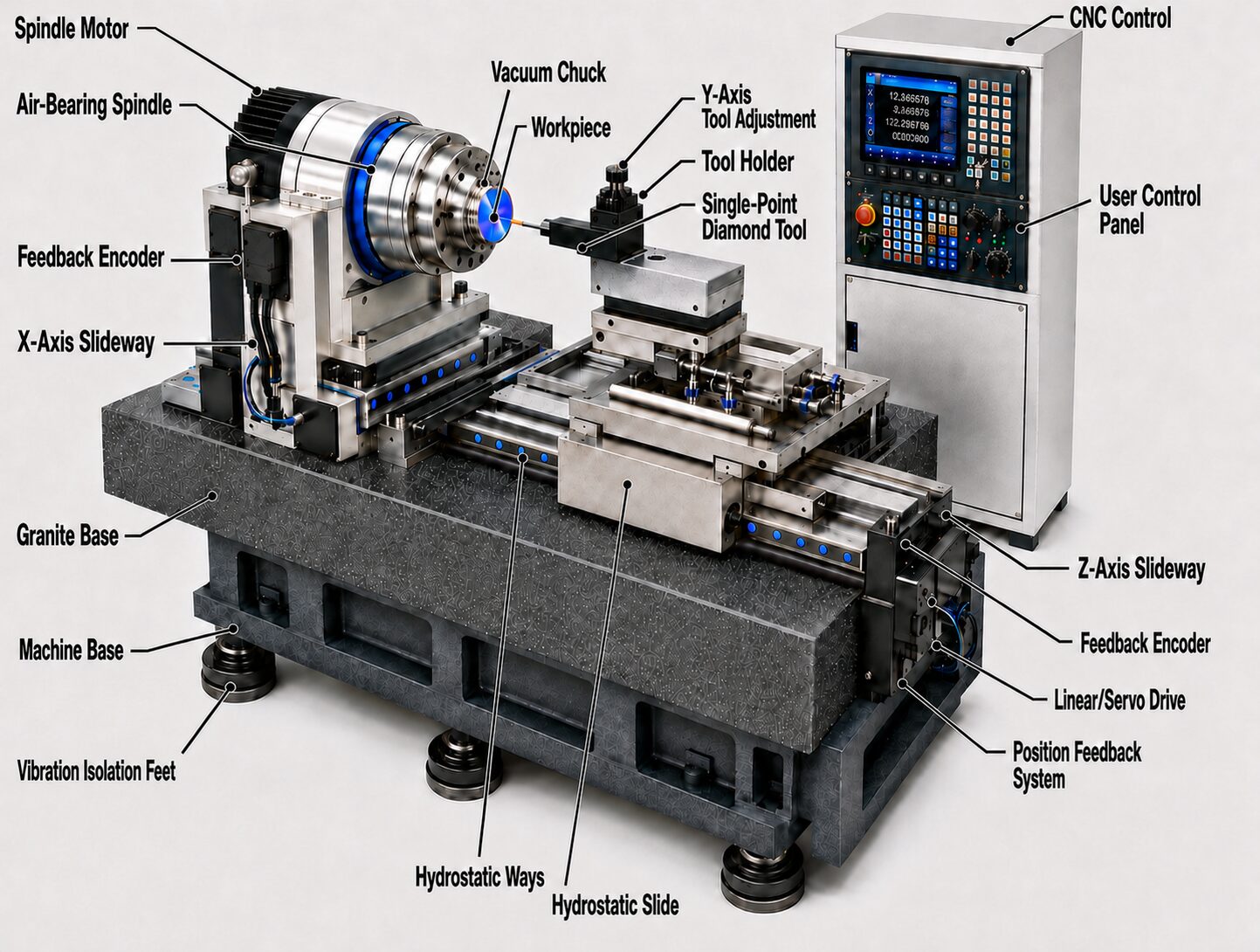
A diamond turning machine is best understood as a coordinated precision system rather than as a collection of independent components. The machine base supports the function of the entire system, the slideways guide linear motion, the spindle rotates the workpiece, the CNC control commands movement, the feedback system reports actual position, and the diamond tool removes material. If any one of these elements moves unpredictably, the finished surface can contain form error, waviness, or roughness that was never intended by the program.
The machine base, slideways and servo system, spindle, CNC control and feedback resolution, and diamond tool are the principal elements of the machine. Each component must function at an accuracy level that is far tighter than what is typical on conventional production lathes.
Machine Base, Stiffness, and Vibration Isolation
Ultra-precision machines commonly use massive, dimensionally stable bases, often granite structures, because the base must resist distortion while supporting the spindle and motion axes. A stiff machine structure is important because cutting forces, axis acceleration, and environmental vibration can create relative movement between the tool and workpiece. Even if that movement is extremely small, it can be transferred directly into the optical surface.
For the same reason, active vibration isolation may be used to reduce vibration transmitted from the floor or surrounding equipment. The objective is not merely to make the machine feel quiet; it is to prevent unwanted displacement at frequencies that could become visible as periodic surface structure. In ultra-precision manufacturing, a vibration that would be insignificant on a conventional lathe can be large compared with the surface errors being controlled.
Slideways and Servo Motion
The linear axes of a diamond turning machine must move smoothly, straight, and predictably. The machines use hydrostatic slides and linear-motor drive systems, with straightness errors measured at extremely small levels. Hydrostatic slideways use a pressurized fluid film to support moving components with virtually no friction and without the conventional sliding contact found in many machine tools. Earlier ultra-precision systems also used ball screw motors to reduce friction.
Servo systems command and correct axis motion. When the CNC requests a position, the servo system drives the axis while feedback devices report where the axis actually is. Because the tool path may require nanometer-scale corrections, smooth servo behavior and stable mechanical support are essential.
The Air-Bearing Spindle
The workpiece spindle is another critical source of accuracy. Air-bearing spindles support the rotating shaft on a thin film of air, minimizing mechanical contact and helping the spindle rotate with exceptionally low error motion. Most air-bearing spindles are capable of rotational speeds maxing out at the 10,000 RPM mark. Some specific grinding spindles are capable of 80,000+ RPM. All while maintaining excellent rotational accuracy.
Spindle accuracy matters because the rotating workpiece establishes the reference axis for the surface being generated. Radial error motion can influence roundness and form, while axial error motion can influence the surface along the spindle axis. Later lessons will also show why workpiece runout and chuck balance must be controlled before a precision cut is attempted.
CNC Control and High-Resolution Feedback
Modern SPDT machines use CNC controls that support standard machine-tool programming while also integrating tool setting, machine indicators, on-machine metrology, and extremely high-resolution position feedback. Feedback systems capable of resolving motion in the nanometer range allow the machine to detect and command extremely small changes in position, which is essential when producing optical-quality surfaces.
High-resolution feedback alone does not guarantee a perfect surface. Machine stiffness, temperature stability, vibration, servo tuning, spindle accuracy, and diamond tool condition all influence the final result. However, precise feedback allows the controller to continuously compare commanded motion with the machine’s actual position and make very small corrections during machining, helping maintain the accuracy required for single point diamond turning.
Temperature and Machine Position
Temperature is one of the most important environmental variables in ultra-precision machining because machine structures expand and contract as their temperature changes. A small thermal change in a slide, spindle housing, tool holder, workpiece, or machine base can shift the relative position between the cutting edge and the part. When the required accuracy is measured in micrometers or smaller units, thermal growth that seems negligible in ordinary machining can become a major source of error.
Historical SPDT systems used thermal-control methods such as oil showers, and modern machines often use carefully controlled rooms, stabilized fluids, and temperature-managed components. The practical lesson is that an SPDT machine should be allowed to reach a stable operating condition and should not be treated as dimensionally fixed while its temperature is changing.