
Single Point Diamond Turning 1 Section12 Lessons1 Quiz12 Weeks
Lesson 1 – Introduction to Single Point Diamond Turning
What You Will Learn
- Define Single Point Diamond Turning (SPDT) and explain how it produces optical-quality surfaces
- Describe how diamond turning developed into an ultra-precision manufacturing process
- Identify common products made with SPDT
- Explain the main advantages of diamond turning
- Recognize advanced SPDT capabilities such as aspheres, freeforms, Fresnel surfaces, and lens arrays
What Is Single Point Diamond Turning?
Single Point Diamond Turning, usually abbreviated SPDT, is an ultra-precision machining process in which a single, carefully prepared diamond cutting edge removes material while the machine controls position at extremely small scales. The goal is not simply to make a part that looks smooth; instead, the process is intended to create a surface whose shape, finish, and dimensional accuracy are suitable for optical or other high-performance precision applications. In the training material, diamond turning is described as machining a material with a diamond tool so that an optical-quality surface and a closely controlled geometric shape are produced in the same operation.
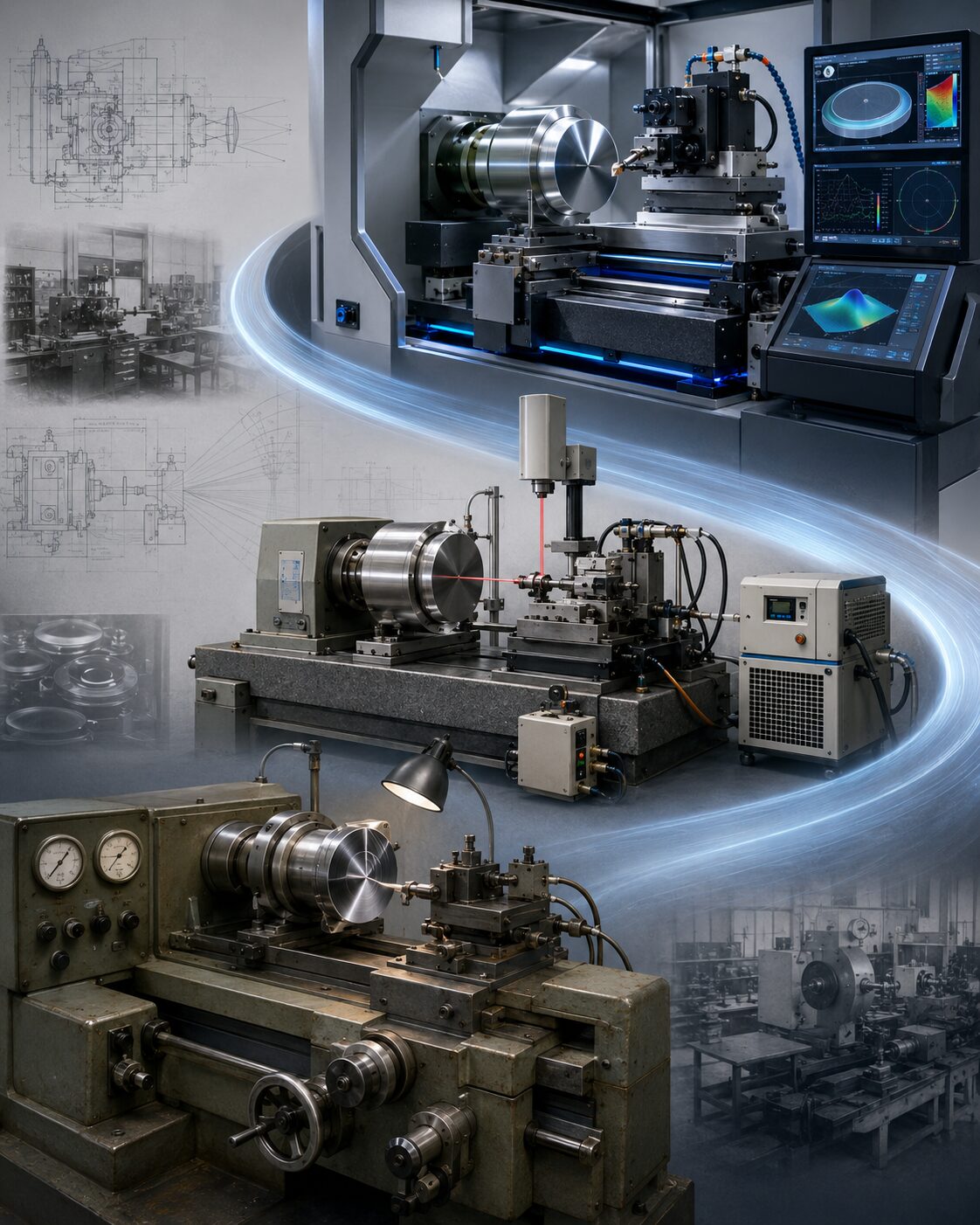 SPDT resembles conventional lathe turning because the workpiece rotates while the cutting tool follows a programmed path, yet the similarity ends quickly once accuracy is considered. Ultra-precision machines use exceptionally smooth hydrostatic ways, rigid structure granite bases, sensitive feedback systems, carefully controlled thermal conditions, and specialized tooling because microscopic changes in machine position can become visible as form error or surface texture on the finished optic.
From Experimental Machines to Modern SPDT
The development of diamond turning accelerated during the 1950s and 1960s as research organizations sought manufacturing methods that could achieve levels of accuracy beyond ordinary machine tools. Early systems were created by modifying high-quality machine bases and combining them with improved spindles and motion-control technology. By the early 1960s, air-bearing spindle technology had become an important part of the process because it reduced mechanical contact and allowed smoother rotation.
During the 1970s, laser distance-measuring interferometers and thermal-control systems were introduced, while commercially available diamond turning machines began to appear. By the 1980s and later, hydrostatic slideways, holographic glass scales, linear motors, CNC controls, on-machine metrology, and increasingly sophisticated error-compensation methods made SPDT more practical and repeatable. Modern systems build on this history by combining mechanical precision with digital measurement and software-based correction.
What SPDT Can Produce
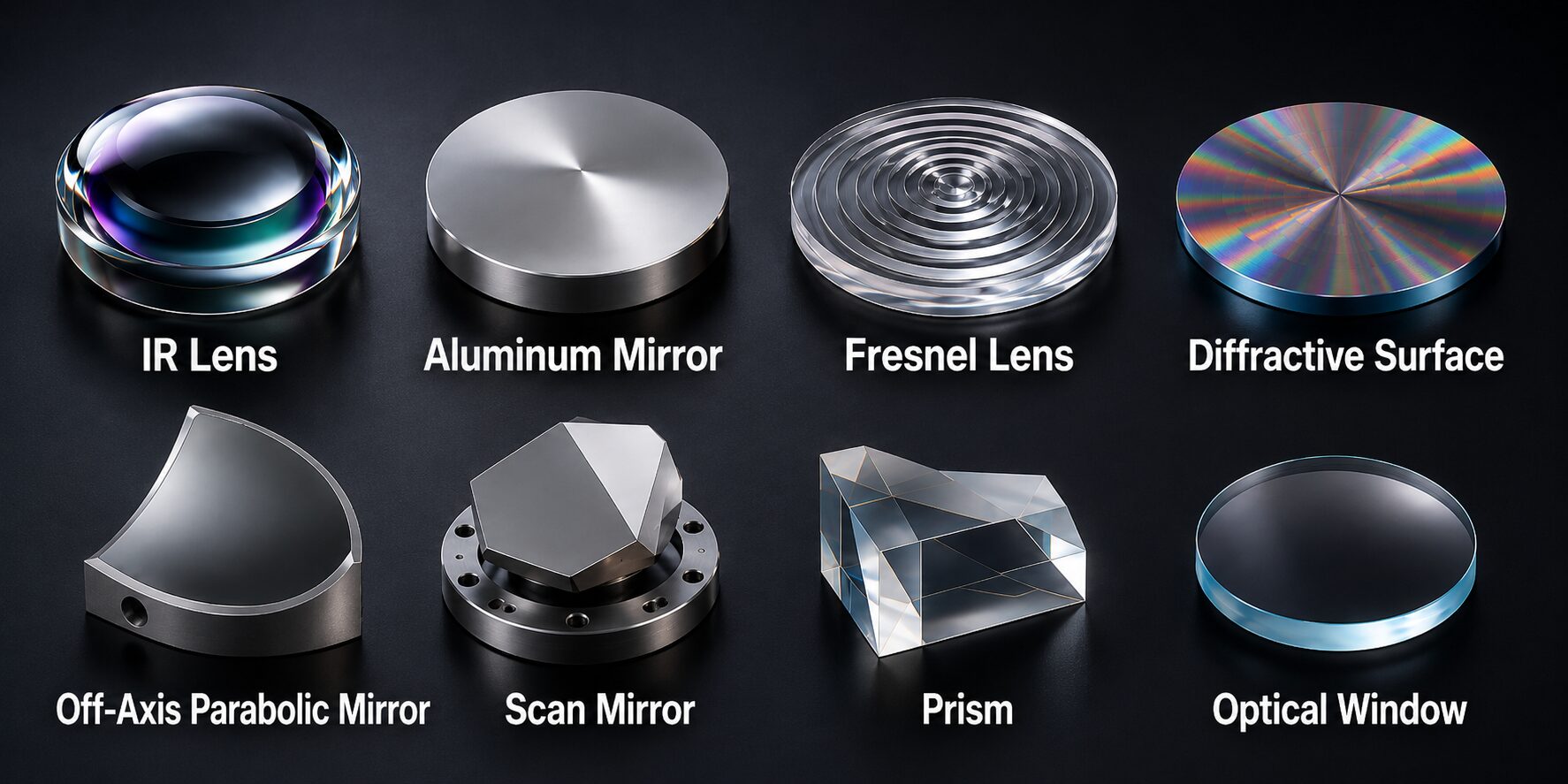
Diamond turning has been used to manufacture or finish a wide range of precision products, including infrared lenses, aluminum mirrors, copper drums used for replication, contact lenses and lens molds, injection-mold tooling, electroform masters, Fresnel structures, diffractive surfaces, off-axis parabolic mirrors, scan components, and other precision optical or electromechanical parts. Some applications are rotationally symmetric, while others depend on advanced machine motion to create complex features.
The process is especially valuable when a material can be cut directly to the required optical finish, because one controlled machining operation can replace several slower steps. This ability becomes important for crystals, polymers, nonferrous metals, and plated surfaces that respond well to diamond cutting.
Why Diamond Turning Matters
SPDT can produce an accurate surface form and an optical-grade finish while preserving tight control over geometry, which makes it particularly useful for components that would be difficult to finish economically by conventional polishing. It is also an important method for creating precision mold surfaces; after a mold is diamond turned, the optical surface can be replicated into glass or plastic parts without machining every finished optic individually.
Another advantage is the direct relationship between programmed tool motion and the resulting shape. When machine geometry, tool position, material behavior, and metrology are controlled, the operator can make purposeful corrections rather than relying only on manual finishing skill. This does not mean the process is automatic or simple, because very small setup errors can produce measurable surface errors, but it does make SPDT a disciplined and data-driven manufacturing method.
Advanced Surface Capabilities
Modern ultra-precision machines extend well beyond ordinary spherical turning. Fast Tool Servo systems use rapidly actuated tool motion to generate nontraditional forms such as torics, micro-prisms, lens arrays, and other structures that change as the spindle rotates. Multi-axis machines can also produce freeform surfaces that are not rotationally symmetric, while specialized methods can create off-axis parabolas, Fresnel features, diffractive structures, and microstructured optical surfaces.
These capabilities illustrate an important idea that will continue throughout the course: SPDT quality depends on the complete system rather than on the diamond tool alone. The machine, workholding, environment, CNC program, metrology, and operator decisions all influence whether the programmed geometry becomes the actual finished surface.