Light Pressure
Small contact patch and lower removal.

During polishing, the tool must maintain smooth and consistent contact with the optical surface. This contact allows the abrasive particles in the polishing slurry to remove material evenly across the workpiece. If contact pressure changes unexpectedly, the removal function also changes. This can produce figure errors, uneven polishing, or poor surface quality. Even slight variations in pressure can create measurable differences in material removal across the optic. Engineers carefully design polishing tools and machine settings to create stable contact throughout the polishing process. Maintaining consistent contact is one of the keys to successful deterministic polishing because it allows the machine to repeatedly produce the same removal behavior.
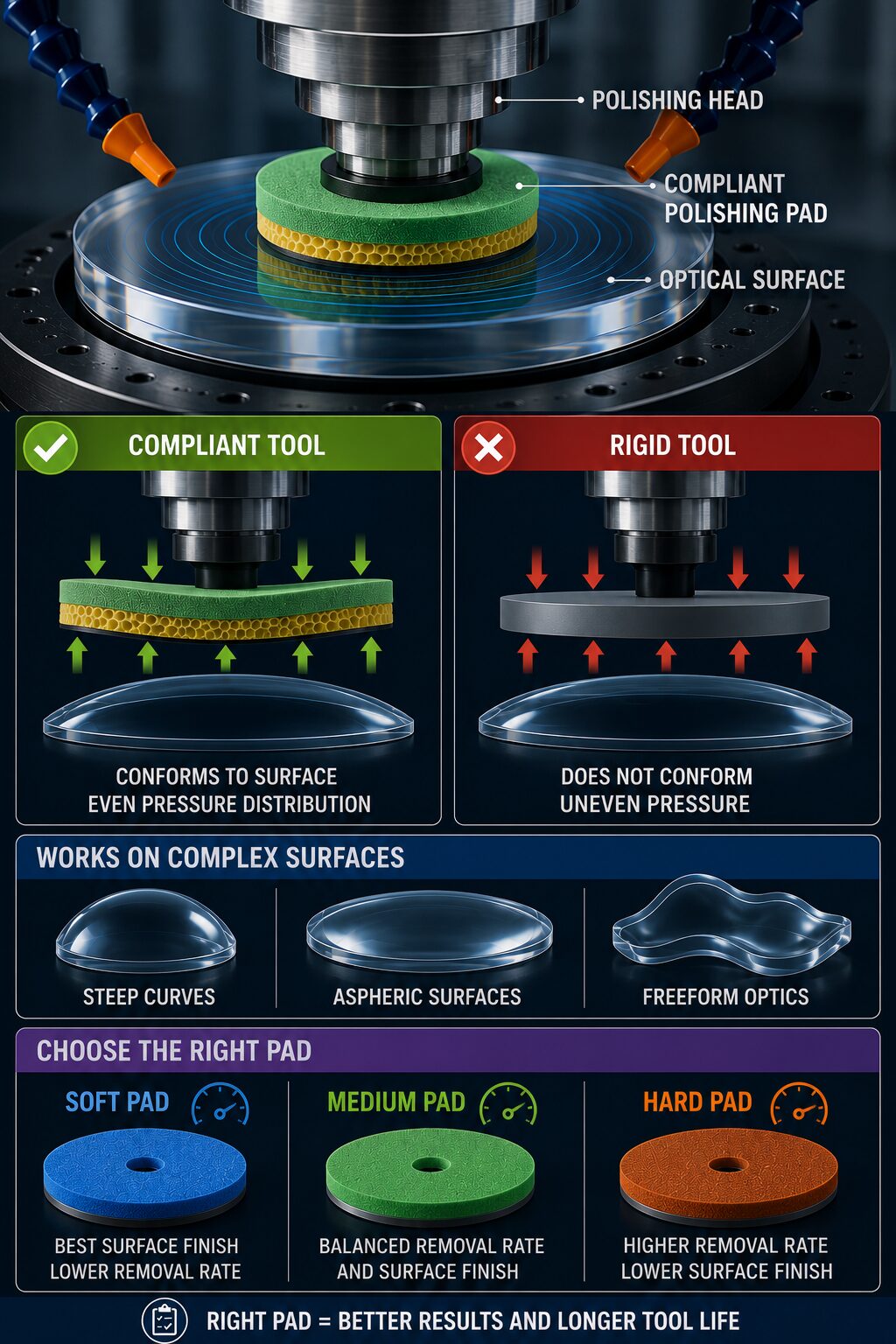 Compliant Polishing Tools
Most UFF systems use compliant polishing tools rather than rigid laps. These tools are slightly flexible, allowing them to conform to changing surface shapes while maintaining consistent polishing pressure.
The flexibility of the tool makes it possible to polish steep curves, aspheric surfaces, and freeform geometries without damaging the optic. It also helps distribute polishing forces more evenly across the contact area.
Different polishing pads may be selected depending on the material being polished, the desired removal rate, and the required surface finish. Choosing the correct pad helps balance polishing speed with surface quality while extending tool life.
Several variables influence how quickly material is removed from the optical surface. Pressure and relative velocity are the primary factors described by Preston’s Law, but other conditions also play important roles. Tool wear, slurry condition, abrasive size, polishing pad material, temperature, and machine stability all affect polishing performance. Even small changes in one of these variables can alter the removal function. A polishing pad that has become worn or contaminated may remove material differently than a new pad, even when all machine settings remain the same. For this reason, technicians monitor process conditions carefully throughout production to maintain consistent polishing results.
Successful deterministic polishing depends on consistency. Operators routinely inspect polishing tools, clean machine components, replace worn polishing pads, and verify machine calibration. Stable polishing conditions allow the removal function to remain predictable from one polishing cycle to the next. This reduces rework, shortens production time, and improves manufacturing efficiency. Careful process control also helps ensure that every optical component meets its required specifications while producing repeatable, high-quality results.
The Contact Pressure Simulator allows you to adjust polishing force and observe how the contact area changes. You can compare light, moderate, and heavy polishing pressure while viewing the predicted removal pattern. As you change the pressure, notice how the contact area and expected removal profile respond. This exercise demonstrates why maintaining consistent polishing conditions is essential for achieving accurate optical surfaces.
Adjust polishing force to see how contact area, pressure distribution, and the predicted removal pattern respond.
Small contact patch and lower removal.
Balanced contact area and removal.
Wider, deeper removal with more risk.