UltraForm Finishing (UFF) is a computer-controlled polishing system designed to produce high-precision optical surfaces. It combines CNC motion, compliant polishing tools, and accurate metrology to remove material in a controlled and repeatable way. Unlike conventional polishing, UFF continuously adjusts the polishing path based on measured surface errors. Instead of polishing the entire optic equally, the machine removes material only where corrections are needed. This produces better accuracy while reducing polishing time. UFF is widely used for manufacturing spherical, aspheric, and freeform optics that require tight tolerances and excellent surface quality.
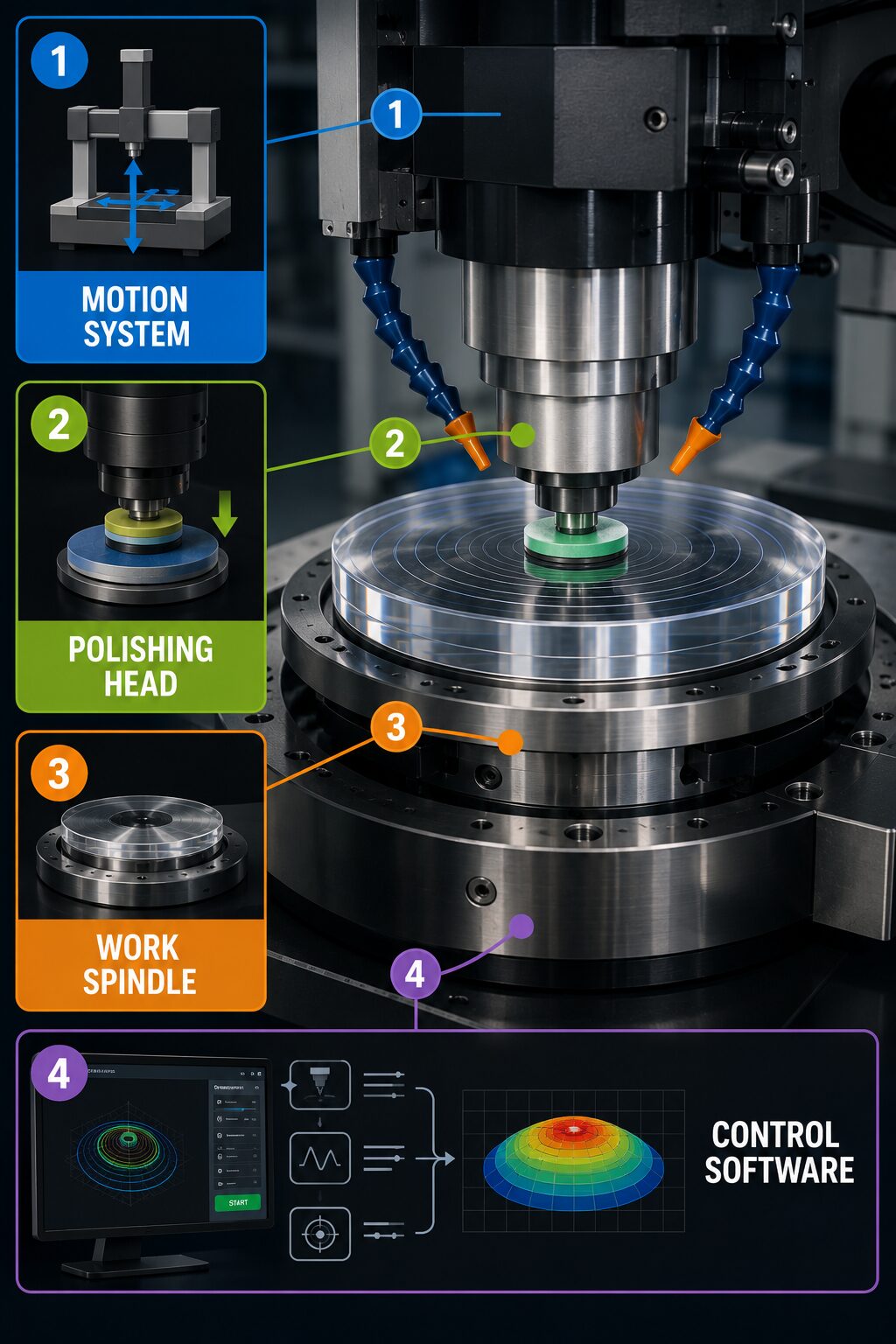
Major Machine ComponentsAlthough UFF systems vary slightly between models, they all contain several key components.
The CNC motion system precisely moves the polishing tool across the optical surface. Servo motors control movement in multiple axes, allowing the machine to follow complex toolpaths with excellent repeatability.
The polishing head holds the compliant polishing tool and controls polishing pressure. During operation, the machine carefully regulates both force and motion to maintain a stable removal function.
The work spindle securely holds the optical component while allowing accurate positioning throughout the polishing cycle.
Finally, the control software coordinates machine motion, polishing parameters, and metrology data to produce the finished optic.
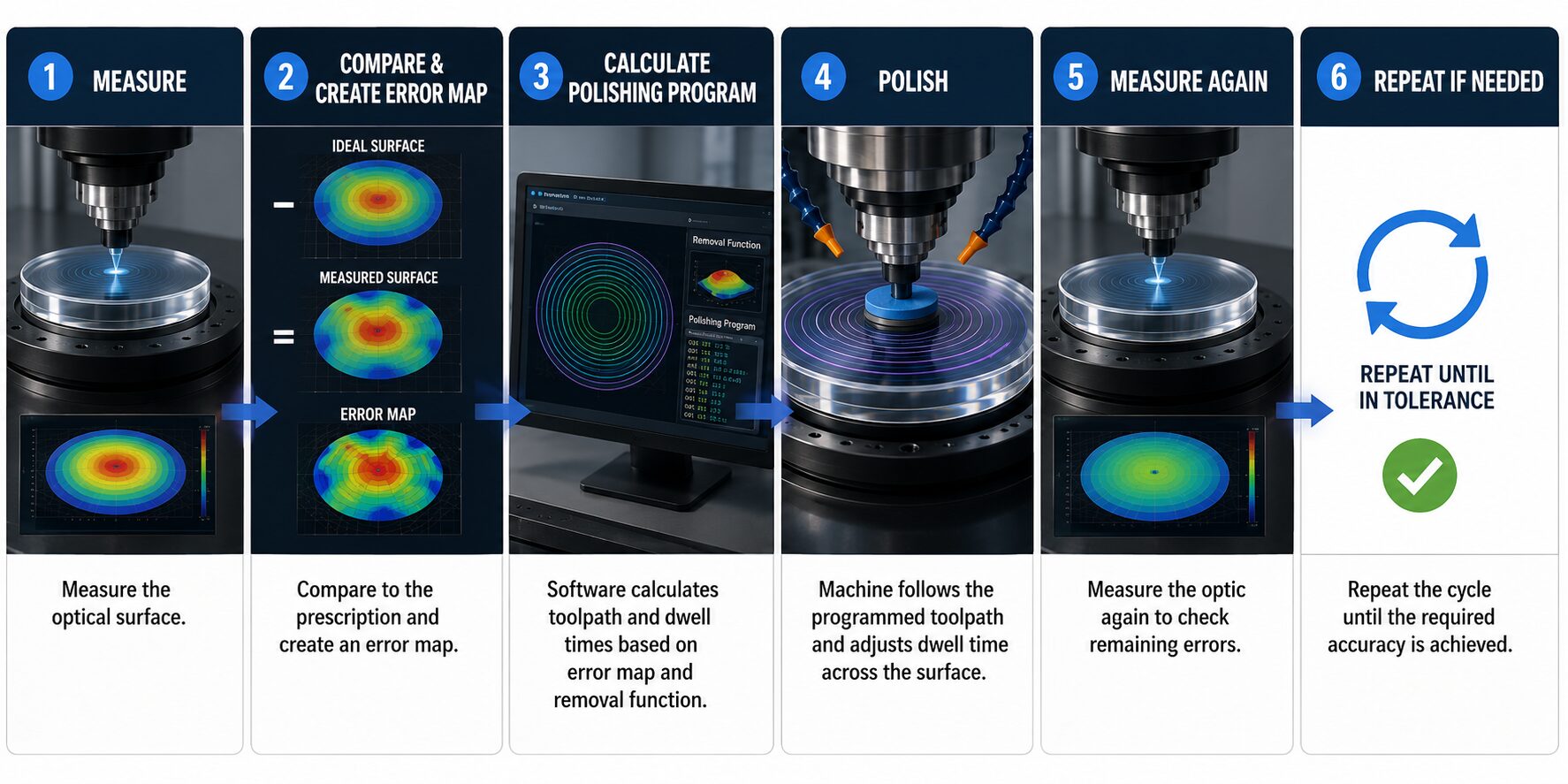
A typical UFF polishing cycle begins by measuring the optical surface. The measurement is compared to the desired optical prescription, creating an error map that identifies where material must be removed. Next, the software calculates a polishing program based on the measured errors and the removal function of the polishing tool. The machine then follows the programmed toolpath while adjusting dwell time across the surface. Areas requiring greater correction receive more polishing time, while areas already within tolerance receive less. After polishing, the optic is measured again. If necessary, another polishing cycle is performed until the required accuracy has been achieved.
One of the greatest strengths of UFF is its flexibility. Operators can change polishing parameters through software instead of replacing large amounts of hardware. Because the machine follows CNC toolpaths, it can polish simple spherical lenses, complex aspheres, and freeform optics using the same basic equipment. This reduces setup time while increasing production capability. The combination of precise machine motion, accurate metrology, and predictable material removal makes UFF one of the most versatile deterministic polishing systems available.
The UFF Machine Explorer allows you to examine the major components of the polishing system. Clicking on each section displays its function and explains how it contributes to the polishing process. This activity helps visualize how the motion system, polishing head, spindle, and control software work together to produce precision optics.
Click the major machine components to learn how motion, tooling, rotation, metrology, and control work together.