
Lesson 2 – Optical Surfaces and Applications
What You Will Learn
- Identify common optical surface geometries.
- Explain the differences between spherical, aspheric, and freeform optics.
- Describe why different surfaces require different polishing methods.
- Recognize common applications for each surface type.
- Understand how surface geometry affects the polishing process.
Understanding Optical Surfaces
Every optical component begins with a design. That design determines how light will travel through or reflect from the surface. Some optics have simple shapes that are easy to manufacture, while others have complex curves that require advanced polishing techniques.
Subaperture polishing is valuable because it can produce many different surface shapes with high accuracy. Unlike traditional polishing methods, which work best on simple spheres, deterministic polishing can make small corrections across almost any optical geometry. This flexibility has made it one of the most important technologies in modern optics manufacturing. Before learning how to polish these surfaces, it is important to understand the different types of optics you may encounter.
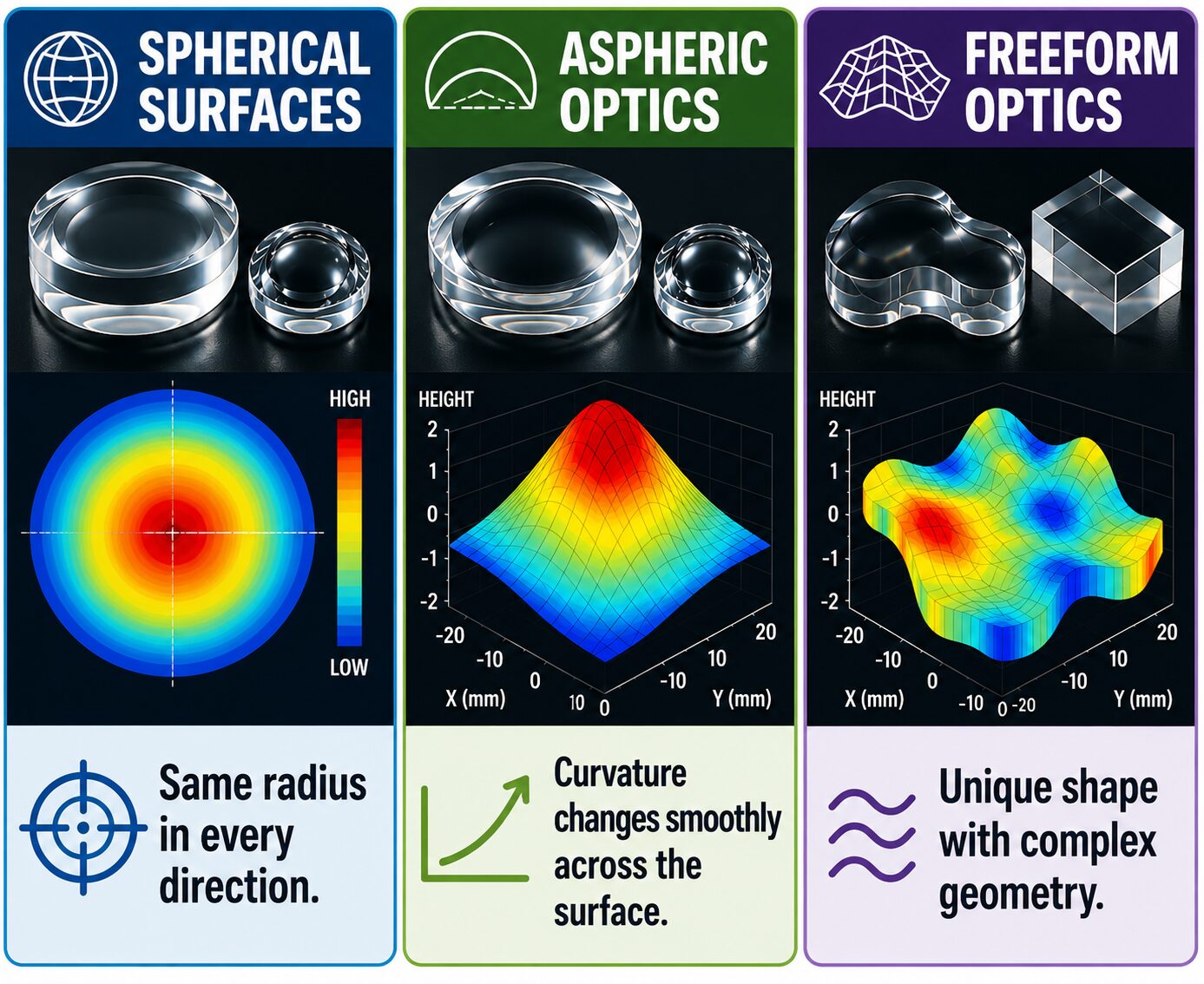 Spherical Surfaces
Spherical surfaces are the most common optics produced in manufacturing. Every point on the surface follows the radius of a sphere, making these optics relatively simple to generate, polish, and measure. Many camera lenses, windows, prisms, and microscope components contain spherical surfaces because they are economical to manufacture and perform well in many optical systems. Although spherical optics can often be polished using conventional full-aperture laps, subaperture polishing is frequently used during the final finishing stages. It allows technicians to remove small figure errors without affecting the entire surface, improving both accuracy and cosmetic quality.
Aspheric and Freeform Optics
Aspheric optics do not follow a constant radius. Their curvature changes from the center to the edge, allowing them to reduce optical aberrations while using fewer lens elements. This improves image quality and often makes optical systems smaller and lighter.
Freeform optics are even more complex. These surfaces may have different curvatures in multiple directions and often lack rotational symmetry. Because every location on the surface is unique, they cannot be manufactured using traditional polishing methods alone.
Subaperture polishing allows these complex surfaces to be corrected one small area at a time. Computer-generated toolpaths continuously adjust the polishing pattern to match the changing surface geometry.
Where These Optics Are Used
Different industries require different optical geometries. Spherical optics are commonly used in consumer cameras, microscopes, laboratory instruments, and general imaging systems. Aspheric optics are widely used in laser systems, medical imaging equipment, infrared cameras, and high-performance camera lenses because they improve image quality while reducing size and weight. Freeform optics are becoming increasingly common in aerospace, automotive sensors, augmented reality displays, defense systems, and advanced scientific instruments. Many of these components could not be manufactured economically without deterministic polishing. As optical systems continue to become more advanced, manufacturers increasingly rely on subaperture polishing to produce these demanding geometries.
Interactive Surface Geometry Viewer
The Surface Geometry Viewer allows you to compare spherical, aspheric, and freeform surfaces in three dimensions. As you rotate each model, notice how the curvature changes across the surface. The viewer also demonstrates why a small polishing tool can adapt to changing surface shapes much more effectively than a large polishing lap. Understanding these differences will make later lessons on toolpaths and machine motion much easier to understand.
Interactive Full Aperture Pad Guide
Compare common pad behaviors, review the correct preparation sequence, and recognize when maintenance or replacement is needed.
How Does the Pad Material Change the Process?
Choose one material. The guide shows its typical conformity, figure-control behavior, slurry transport, and best use.
Polyurethane
Prepare the Pad in the Correct Order
Use the Next button to move through the six essential preparation steps.
What Is the Pad Telling You?
Choose the main warning sign. The guide recommends the next action.
Recommended Action
Every optical surface presents unique manufacturing challenges. Simple spheres can often be polished using conventional techniques, while aspheres and freeform optics require deterministic polishing to achieve the required accuracy. In the next lesson, you’ll learn how deterministic polishing works and discover how metrology, removal functions, and CNC motion combine to predict material removal before polishing begins.