
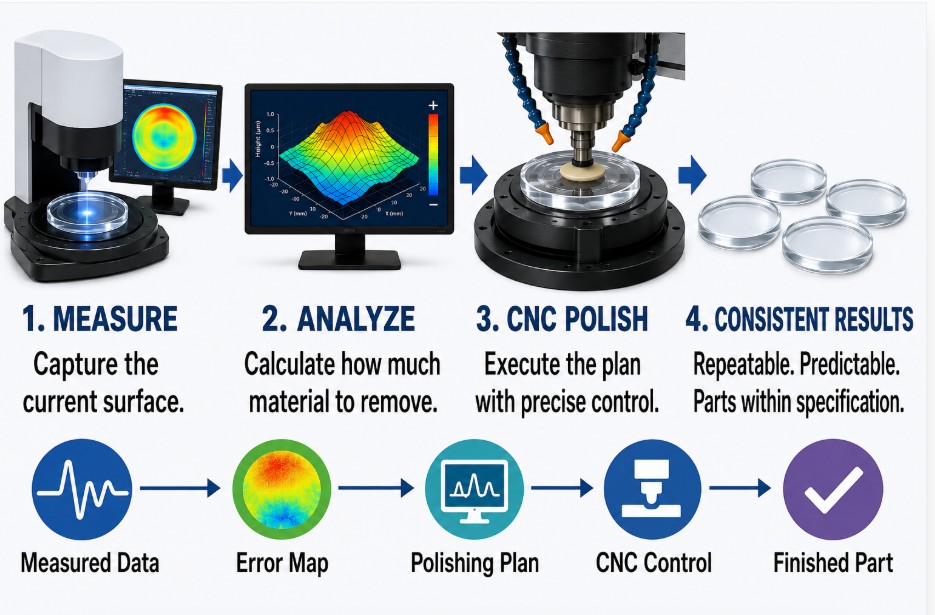
 Deterministic polishing is a manufacturing process that predicts how much material will be removed before polishing begins. Instead of relying on operator experience, the process uses measurements, mathematical models, and CNC machine control to produce consistent results. The goal is simple: remove exactly the amount of material needed to bring the optical surface within specification. Because every polishing cycle is based on measured data, the process is repeatable and produces predictable results from part to part.
Live Process Display
Peak Removal
0.55 µm
Correction Volume
0.38 mm³
Final Figure Error
0.31 µm
Removal Footprint
Current polishing pass
Figure Correction
Before versus after
Before
Removed
After
The current dwell time produces a controlled correction that reduces the high spot without overcorrecting it.