
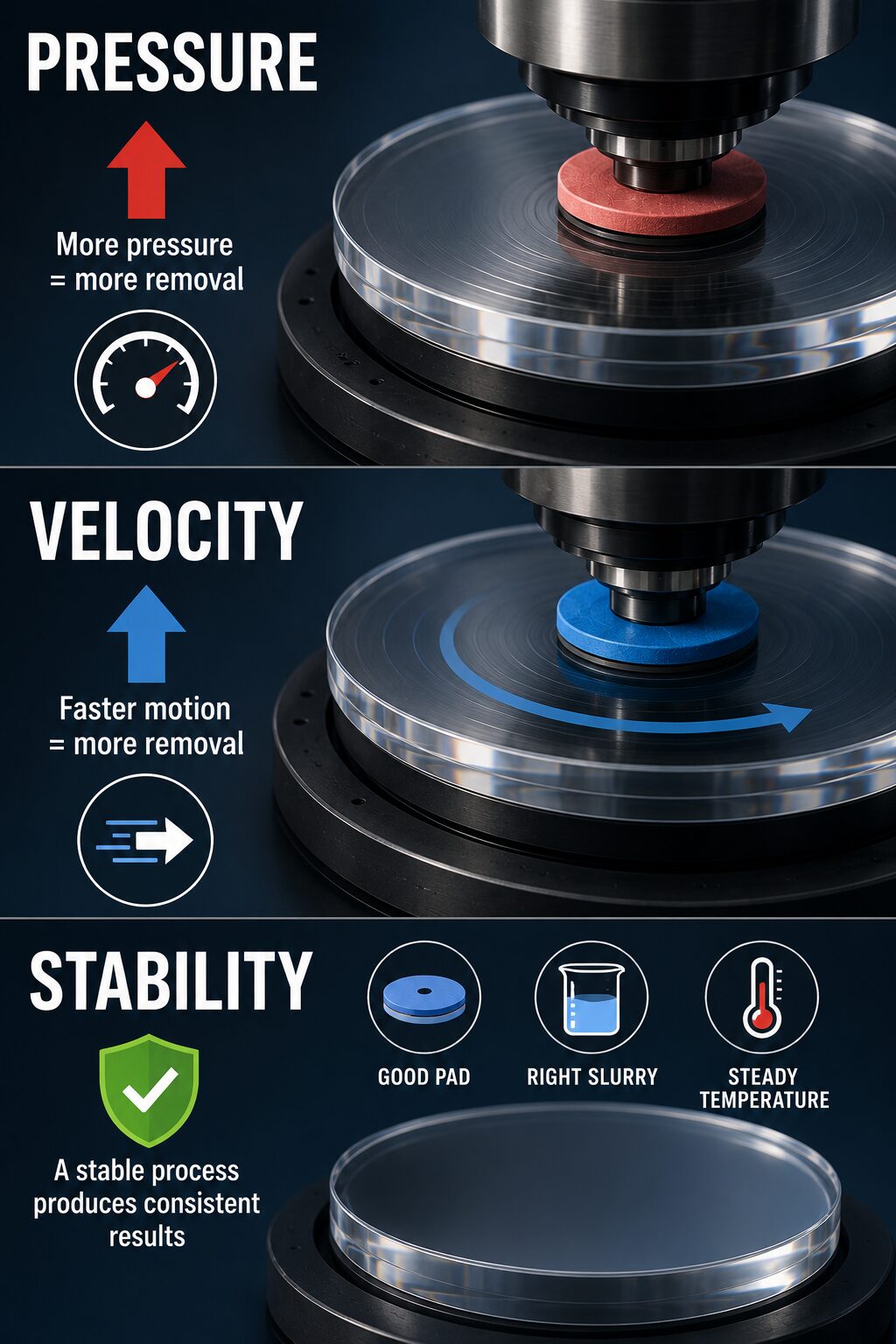
One of the most important relationships in optical polishing is Preston’s Law. It describes how the amount of material removed from an optical surface is related to the pressure between the polishing tool and the optic and the relative velocity between them. Preston’s Law provides the mathematical foundation for understanding and predicting material removal during polishing. While other factors- including abrasive type, tool material, slurry chemistry, temperature, and tool condition- also affect polishing performance, pressure and relative velocity are two of the primary variables controlling removal. Understanding this relationship allows technicians and engineers to predict how changes to polishing conditions will affect the surface rather than relying entirely on trial and error.
Preston’s Law is commonly expressed as:
R = K × P × V
Where:
The Preston’s coefficient, K, represents the effectiveness of the particular polishing system. It is influenced by characteristics of the tool, abrasive, slurry, optic material, and other process conditions.
The equation shows that material removal rate is approximately proportional to both pressure and relative velocity:
R ∝ P × V
This means that, when other conditions remain constant:
For example, if a polishing process produces a removal rate of 1 unit per minute at a particular pressure and velocity, doubling the pressure while keeping velocity constant would produce an expected removal rate of approximately 2 units per minute. If both pressure and velocity are doubled, the predicted removal rate would be approximately 4 units per minute. This simple mathematical relationship is extremely important because it shows that pressure and velocity work together to control how quickly material is removed.
Pressure and Material RemovalPressure is the force applied between the polishing tool and the optical surface. As pressure increases, abrasive particles are generally forced more strongly against the surface, increasing the rate at which material is removed. However, increasing pressure is not always beneficial. Excessive pressure can cause problems such as:
Too little pressure can also be a problem. Removal may become too slow, making the process inefficient or difficult to control. The goal is therefore not to use the highest possible pressure. Instead, the polishing process must use a pressure appropriate for the optic, tool, abrasive system, and desired surface finish. Because pressure directly affects removal rate, it must remain controlled and repeatable when a polishing process is being used to predict material removal.
Relative velocity is the speed at which the polishing tool moves relative to the optical surface. As relative velocity increases, abrasive particles pass over the surface more frequently. Under otherwise identical conditions, this generally increases the material removal rate. For example, if a polishing tool moves twice as fast while maintaining the same pressure, Preston’s Law predicts approximately twice the removal rate. In an actual polishing system, however, the tool does not necessarily move at one constant speed over the entire optic. Machine motion, toolpath geometry, and the location of the tool can all affect relative velocity. For deterministic polishing, these variables must be carefully controlled. Changing pressure or velocity without accounting for its effect on removal can cause the actual result to differ from the predicted result.
Preston’s Law becomes especially useful in subaperture polishing. A subaperture polishing tool is smaller than the optical surface being polished. Rather than covering the entire optic at once, the tool moves across the surface and removes material from selected areas. This allows the polishing system to correct localized surface errors. The basic concept is straightforward:
The tool moves across the optic, and the machine controls how the tool interacts with each area of the surface.
The machine can control variables such as:
By controlling these variables, the polishing system can remove more material where it is needed and less material where it is not. This is what makes subaperture polishing a deterministic process.
One of the most important concepts in deterministic subaperture polishing is dwell time. Dwell time is the amount of time a polishing tool spends acting on a particular location or region of the optical surface. If pressure, velocity, and the other polishing conditions remain constant, increasing the dwell time increases the total amount of material removed. A simplified relationship can be written as:
M = K × P × V × t
Where:
This equation builds on Preston’s Law by showing how the total amount of material removed depends not only on how aggressively the tool polishes, but also on how long it polishes. For example, if one area of an optic requires twice as much material removal as another area, and all other conditions remain constant, the polishing system can achieve this by applying approximately twice the dwell time to that area. This is a fundamental principle of deterministic polishing.
How does a polishing machine know where to spend more or less time? The process begins with metrology. The optical surface is measured to determine how it differs from the desired shape. The resulting measurement identifies areas where material needs to be removed. The polishing system can then calculate a dwell-time distribution that determines how long the subaperture tool should spend at different locations. The process can be summarized as:
Measure → Analyze Surface Error → Calculate Dwell Time → Polish → Measure Again
The cycle is repeated as necessary. If one area contains a larger surface error, the calculated polishing process may apply more dwell time there. If another area is already close to the desired shape, the tool may spend less time there. The objective is to progressively reduce the surface error until the optic meets its required specification. This measurement-and-correction process is one of the foundations of deterministic optical manufacturing.
To calculate dwell time accurately, the polishing system needs to know how the tool removes material. This behavior is described by the removal function. The removal function represents the amount and spatial distribution of material removed by a polishing tool under a specific set of operating conditions. A polishing tool does not necessarily remove the same amount of material everywhere within its contact area. The center of the tool may remove material differently than the edges. The removal function therefore describes not only how much material the tool removes, but also where that material is removed relative to the tool. Once the removal function is characterized, the polishing software can use it to predict the effect of moving the tool across the optic. This information is used to calculate the toolpath and dwell time required to correct the measured surface error.
For deterministic polishing to work as intended, the removal function must remain stable and repeatable. Imagine that a machine calculates a dwell time based on a known removal function. If the polishing tool later becomes worn and removes material more slowly, the same dwell time will no longer produce the expected amount of material removal. The result will be a mismatch between the predicted removal and the actual removal. Several factors can change the removal function, including:
This is why technicians monitor polishing conditions and regularly verify the performance of the polishing system. A stable removal function allows the machine to make reliable predictions. An unstable removal function makes those predictions less accurate.
Preston’s Law provides a simple way to understand the relationship between polishing conditions and material removal:
R = K × P × V
When we consider how long the tool acts on a particular area, we can extend the relationship to:
M = K × P × V × t
These equations connect the basic physics of polishing to the operation of a deterministic subaperture polishing system.
The process can be thought of in three stages:
1. Control the polishing conditions.
Pressure, velocity, and other process variables determine the removal rate.
2. Control the dwell time.
The amount of time the tool spends over a location determines how much material is removed there.
3. Maintain a stable removal function.
The relationship between the machine settings and actual material removal must remain consistent for the calculations to remain accurate.
Together, these principles allow a polishing system to move beyond simply polishing an optic uniformly. Instead, the system can selectively remove material to correct specific surface errors.
The Preston’s Law Calculator allows you to adjust polishing pressure and tool speed while observing how those changes affect the predicted removal rate. Use the calculator to explore the relationship between the variables in Preston’s Law.
Increase the pressure while keeping the tool speed constant. Observe how the predicted removal rate changes. What happens? The predicted removal rate increases because removal rate is proportional to pressure.
Return the pressure to its original value and increase the tool speed. Observe how the predicted removal rate changes. What happens? The predicted removal rate increases because removal rate is proportional to relative velocity.
Increase both pressure and velocity. Compare the resulting removal rate with the original value. This demonstrates an important feature of Preston’s Law: changes in pressure and velocity multiply together.
Adjust polishing pressure and tool speed to observe how multiple process variables change the predicted removal rate.Interactive Preston's Law Calculator
Set the Polishing Conditions
Live Process Display
Preston’s Law provides the mathematical foundation for understanding material removal during optical polishing. The basic relationship is:
R = K × P × V
Pressure and relative velocity determine the rate at which material is removed. In subaperture polishing, dwell time provides another important control:
M = K × P × V × t
By controlling dwell time, a polishing system can selectively remove different amounts of material from different areas of an optic. For this approach to work accurately, the removal function must remain stable and repeatable. Changes in tool condition, slurry, temperature, pressure, velocity, or other process variables can change the actual removal behavior. The key idea is simple: Preston’s Law tells us how polishing conditions affect removal. Dwell time tells us how long the tool acts on a location. The removal function tells us what the tool actually removes. Together, these concepts form the foundation of deterministic subaperture polishing. Pressure and velocity are fundamental to material removal, but they are only part of the overall polishing process. Different subaperture polishing technologies apply these principles in different ways.
In the next lesson, you’ll explore the most common subaperture polishing technologies used throughout the optics industry and learn where each process is most effective.