
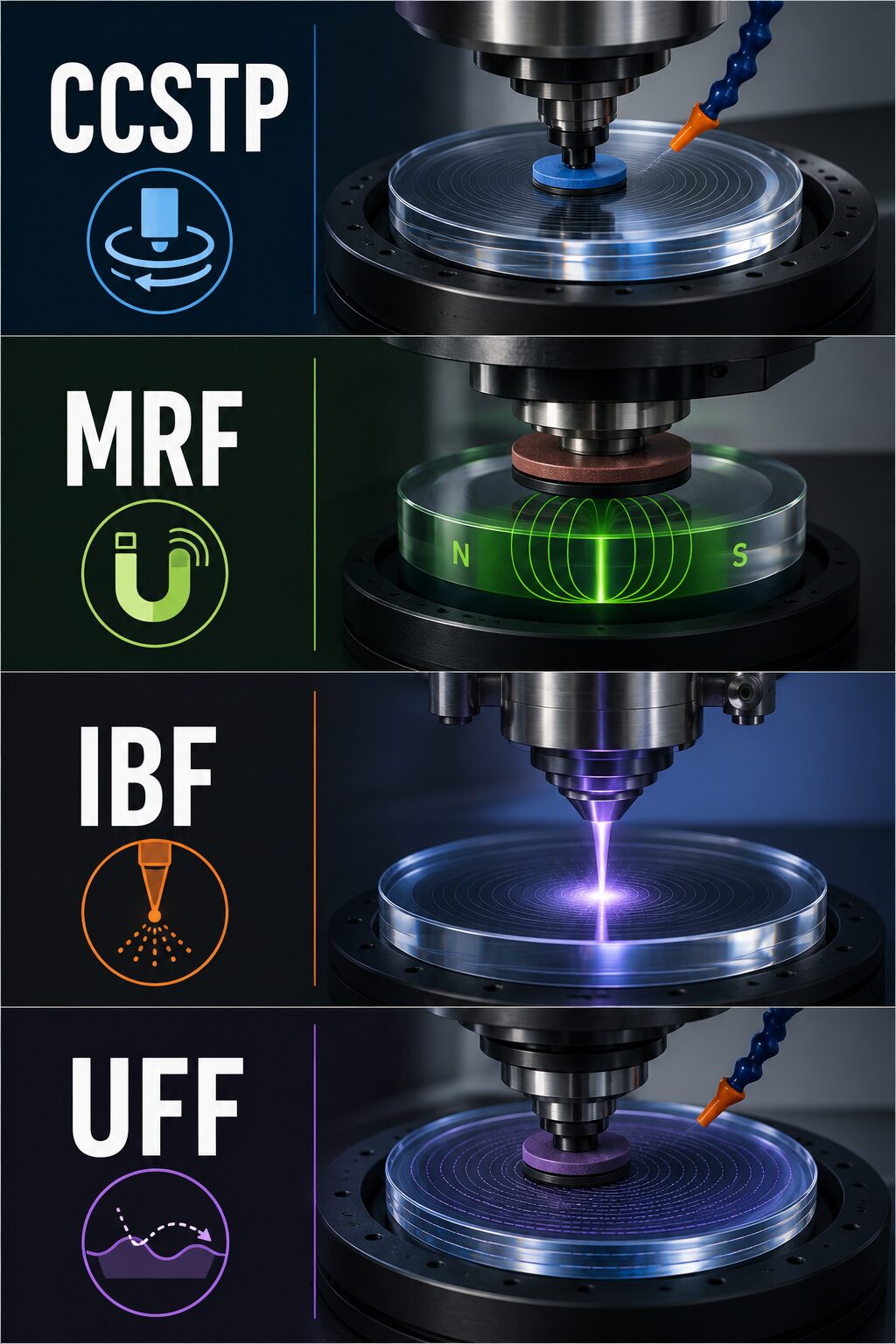
 Computer Controlled Small Tool Polishing (CCSTP) uses rotating polishing tools to remove material through carefully controlled dwell times. It is commonly used for precision lenses and mirrors.
Selected Technologies4
Highest Removal RateCCSTP
Best Fine CorrectionIBF
Broadest Geometry RangeUFF
| Comparison Area | CCSTPComputer-Controlled Small Tool Polishing | MRFMagnetorheological Finishing | IBFIon Beam Figuring | UFFUltraForm Finishing |
|---|---|---|---|---|
| Advantages | Flexible tooling, relatively high removal, and strong broad corrective polishing. | Highly repeatable removal function, deterministic control, and excellent finish. | No mechanical contact, extremely precise correction, and minimal tool stress. | Adapts to complex aspheres and freeforms with controlled local removal. |
| Limitations | Tool wear, edge effects, and process stability must be managed. | Specialized fluid and equipment; some geometries and materials are challenging. | Slow removal, high equipment cost, and vacuum processing. | Requires accurate calibration, advanced motion control, and stable setup. |
| Relative Removal Rate | High | Medium | Low | Medium–High |
| Typical Applications | Bulk correction, aspheres, large optics, and pre-finishing. | Precision aspheres, high-value optics, final correction, and finish improvement. | Final nanometer-scale figuring, delicate optics, and post-polish correction. | Complex aspheres, freeforms, local corrections, and difficult regions. |
| Achievable Surface Quality | Good | Excellent | Excellent figure control | Very Good |
| Complex Geometry Capability | Good | Very Good | Good with line of sight | Excellent |
Why Manufacturers Combine Technologies
No single process is best at every stage. A faster technology may perform the initial correction, followed by a slower and more precise process for final figure and surface quality.
Example Combined Process
CCSTP Bulk Correction→UFF or MRF Refinement→IBF Final Figuring
All four technologies are selected. Compare their strengths to see how they can support different stages of one manufacturing process.