
KEVIN 9.0
KEVIN organizes part geometry, current measurements, process settings, historical outcomes, and technician feedback into one guided optical-polishing workflow. It gives technicians a practical recommendation they can understand- not a mysterious answer they are expected to trust blindly.
KEVIN quick access
Open the advisor, review the instructions, understand how the data is handled, or access the protected run repository.
Enter a part, measurements, and process settings to generate a reviewable recommendation.
Use the step-by-step guide to understand each input, calculation, and result field.
See how process information is stored, protected, and used inside the KEVIN environment.
Authorized users can review completed outcomes and manage the historical run database.
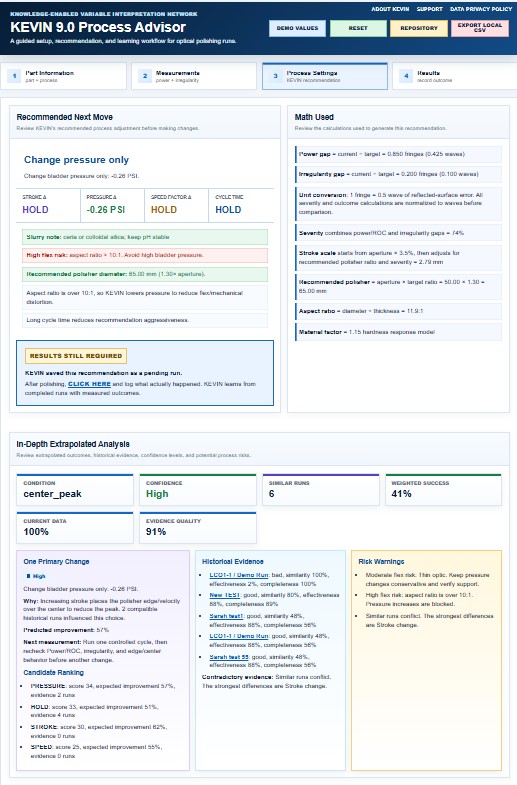
Turns a polishing problem into a clear, reviewable workflow.
KEVIN collects the information that often lives in separate notes, spreadsheets, interferometer results, machine settings, and technician experience- then keeps it connected to the recommendation and the final outcome.
Captures geometry, material, pad, slurry, tool size, pressure, motion, speed, and cycle details.
Calculates power, ROC, and irregularity gaps while keeping waves and fringes in compatible units.
Uses the entered conditions, selected form-error pattern, risk checks, and relevant historical evidence.
Links the final measurements and actual changes back to the recommendation so the result can be evaluated.
Four steps from setup to usable outcome data.
The recommendation matters, but the result is what makes KEVIN more useful over time. Completing all four steps keeps the knowledge connected.
Add geometry, material, tooling, slurry, and current machine setup so KEVIN has the right context.
Enter power, radius, irregularity, targets, units, priority, and the observed form-error pattern.
Check the suggested adjustment, calculations, confidence, historical evidence, and risk warnings.
Return after polishing and record the actual settings and final measurements to complete the run.
Make useful polishing knowledge easier to capture, share, and improve.
KEVIN is designed to reduce avoidable trial and error, preserve what technicians learn from real runs, and give the next person a better place to start. Its long-term value comes from recording what actually happened- not only generating an initial recommendation.
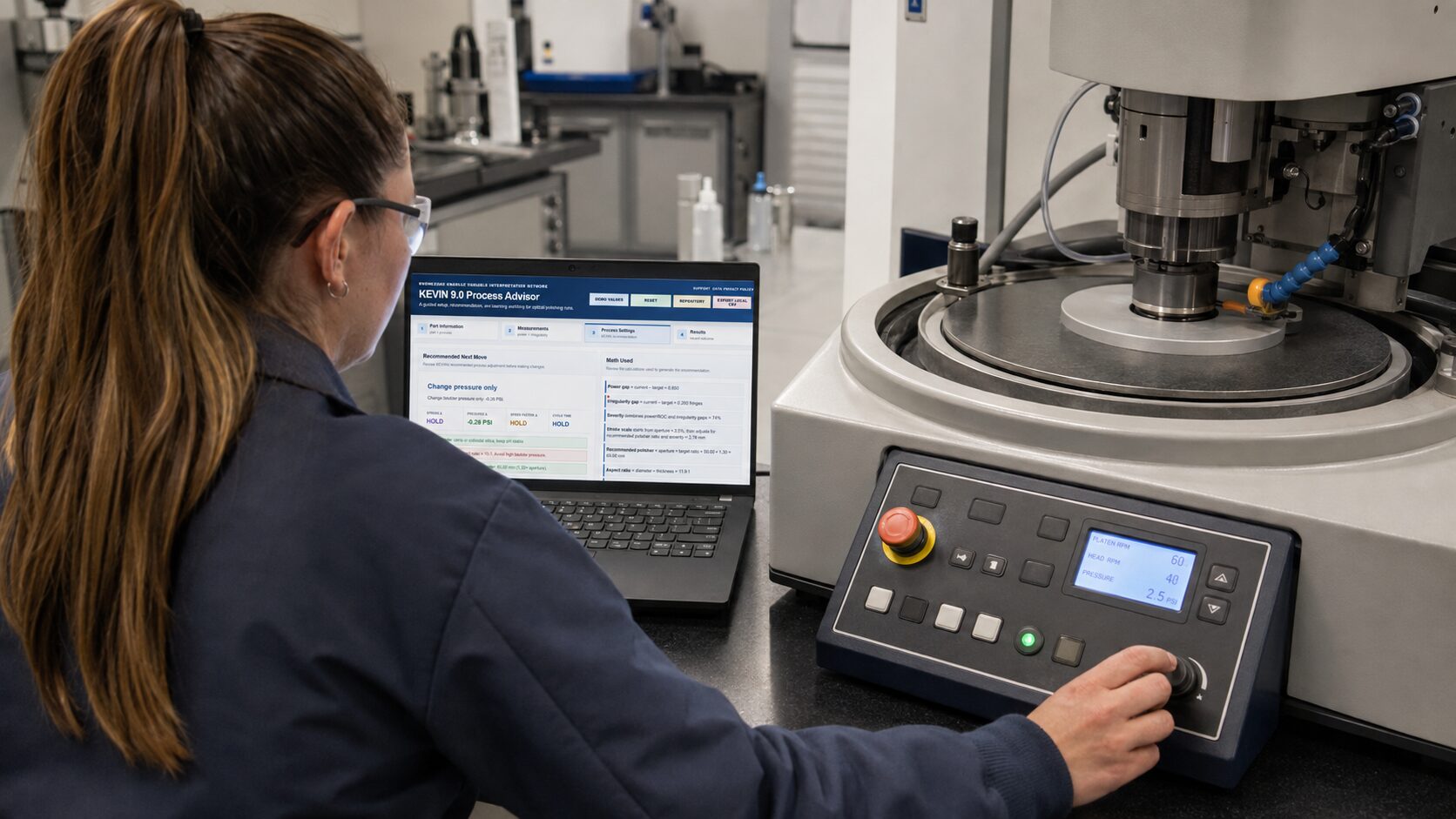
Build the precision optics knowledge behind the recommendation.
KEVIN can organize a decision, but the best results still come from people who understand the optic, the process, and the measurement. Learn.AmeriCOM offers free, self-paced courses created for the optics workforce.
Explore practical courses for technicians, students, engineers, supervisors, and anyone building skills in optical manufacturing.
Learn to identify dimensions, tolerances, radius, power, irregularity, surface quality, wedge, and other optical drawing requirements.
Review polishing purpose, pitch laps, slurry, tooling, contact, motion, process stability, and common polishing problems.
Strengthen measurement skills for thickness, sag, radius, wedge, power, irregularity, waviness, and surface finish.
Explore removal functions, toolpaths, CNC motion, contact mechanics, metrology, process control, and troubleshooting.
Training, manufacturing technology, and industry collaboration.
KEVIN is one part of a larger effort to strengthen the precision optics workforce and manufacturing base.
AMERICOM
AmeriCOM works with industry, education, government, and nonprofit partners on workforce development, manufacturing technologies, and the long-term strength of the precision optics industrial base.
DPOC brings together U.S. optics manufacturers, academic institutions, nonprofits, and government partners to address technology development, standards, supply-chain issues, research, and education.
Learn.AmeriCOM provides practical, self-paced courses for people discovering optics, preparing for hands-on training, or building skills while working in the industry.