
Lesson 8: Slurry Fundamentals – Abrasive, Concentration & pH
What You Will Learn
- How to choose abrasives (ceria, alumina, diamond, colloidal silica, zirconia)
- Why concentration and pH affect removal and cosmetics
- Setup practices for recirculated vs. drip-fed slurries
Simple Explanation
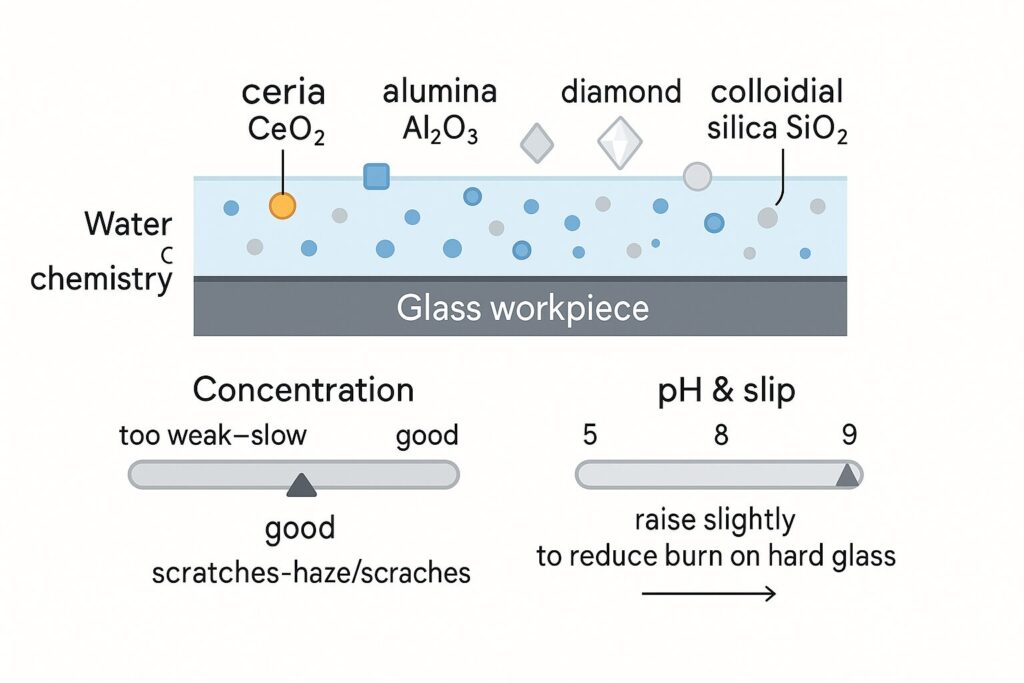 Think of slurry as tiny hard grains floating in water with a bit of chemistry mixed in. The grains do the gentle “rubbing,” and the chemistry helps them slide and react with the surface. Ceria (CE-ree-ah) is common for many optical glasses because it both polishes and lightly reacts with the glass. Alumina and diamond are strong choices for harder crystals. Colloidal silica is a very fine, smooth slurry used for final surface finishing of brittle crystal materials. If the slurry is too weak, polishing is slow. If it’s too strong, you can scratch or leave a hazy film. The acidity or basicity of the water (the pH) changes how “slippery” the contact is and can help or hurt the finish.
Deeper Explanation
Abrasive choice.
Ceria and zirconia are often used on optical glasses because they support a chemical-mechanical action that gives good removal with a clean finish. Alumina and diamond are tougher grains used for hard or crystalline materials (like some infrared crystals or sapphire). Colloidal silica has very small, smooth particles and is commonly used as a finishing slurry to improve surface quality.
Concentration (how “strong” the mix is).
In many shops, recirculated ceria slurries are checked with a hydrometer and kept around 3–5 Baumé (°Bé). That range is a practical starting point, not a rule. Lower than that, removal can “starve.” Higher than that, particles may clump or cut too aggressively. Drip-fed systems often follow the vendor’s ratio or a shop-tested recipe. Whatever the system, the key is consistency: measure, mix the same way each time, and record what you did.
pH (how acidic or basic the water is).
A pH near 7 (neutral) is a safe default for many glasses. If you see “burn”, sleeks, brush marks, “orange peel”, or staining on difficult glass materials, gently raise the pH into the 8–9 range can add slip and lower friction. Big jumps in pH can cause trouble, so make small adjustments, test, and log the result. Always match pH and abrasive to the material you are polishing. Document and save your process parameters for reference.
Recirculated vs. drip-fed slurries.
Recirculated systems hold slurry in a tank and pump it back to the tool. They need filtration, agitation, and regular checks so particles don’t settle or clump. Drip-fed systems deliver a fresh mix to the lap and send the used slurry to waste; they are simpler to keep clean but use more slurry over time. Choose the approach that fits your process control and cleanliness needs.
Measuring and keeping control.
Use a hydrometer to read °Bé for strength, and a pH meter or pH strips to read acidity/basicity. Strain slurry through clean filters so large clumps don’t reach the lap. Keep tanks, lines, and nozzles clean. Temperature matters too: warmer slurry can thin out and flow more; cooler slurry can thicken and slow removal.
Material pairing (quick guidance).
For common optical glasses, start with ceria or zirconia and tune concentration and pH for speed vs. finish. For crystals and very hard materials, start with alumina or diamond for stock removal, then move to a finer abrasive (often colloidal silica) to improve the final look.
Process Steps
Begin by picking an abrasive that matches the material and the stage of work. For early material removal, use a tougher or larger particle; for final finish, use a finer, smoother slurry. Mix your slurry to the target strength. If you recirculate, bring it into the 3–5 °Bé range as a starting point and note the reading. If you drip-feed, follow your proven recipe. Check pH and aim near neutral unless your material needs a small push higher for slip. Before a long run, strain the slurry, verify good flow, and flush the lines so old, settled slurry does not contaminate the lap.
Operator Tips
Material Removal Rate (MRR) will change at different °Bé and pH settings, document the process parameters used on successful setups. Use de-ionized water and the same mixing order every time to reduce variability. Stir or circulate gently so particles stay suspended without whipping in bubbles. Keep lids on tanks to limit contamination and evaporation. Clean filters, hoses, and nozzles on a schedule so you don’t fight hidden clogs. Maintain clean work environment avoid contamination of any kind.
Common Defects & Fixes
If you see sleeks or a soft haze, improve filtration and strain the slurry, then check whether the mix is too strong or the particles are clumping. A small move toward neutral pH often helps. If removal is too slow, confirm the °Bé reading, gently increase concentration, and verify steady flow across the lap. Adjusting the pH slightly and the Baume can help improve surface finish. Confirm that the lap is properly conditioned, check grooves, and pitch thickness and hardness. If scratch counts rise suddenly, stop, flush the system, change filters, remix fresh slurry, try making a new polisher, add additional grooves, reduce pressure, check slurry concentration.
Slurry Selector & Mixer
Match the abrasive, then set strength & pH. Press Run at the bottom.