
Lesson 4: Pitch Types & Hardness (Gugolz, Cycad, Synthetic)
What You Will Learn
- Distinguish between natural and synthetic pitch families and explain their advantages and limitations.
- Interpret how hardness and softening points are specified, and how they translate into polishing behavior
- Evaluate the impact of environment, temperature, and load on pitch performance.
- Select the appropriate pitch type for a given optical requirement, whether ultra-smooth finish, durability under load, or stability across conditions.
- Apply best practices in balancing pitch hardness with surface quality, process efficiency, and lap maintenance.
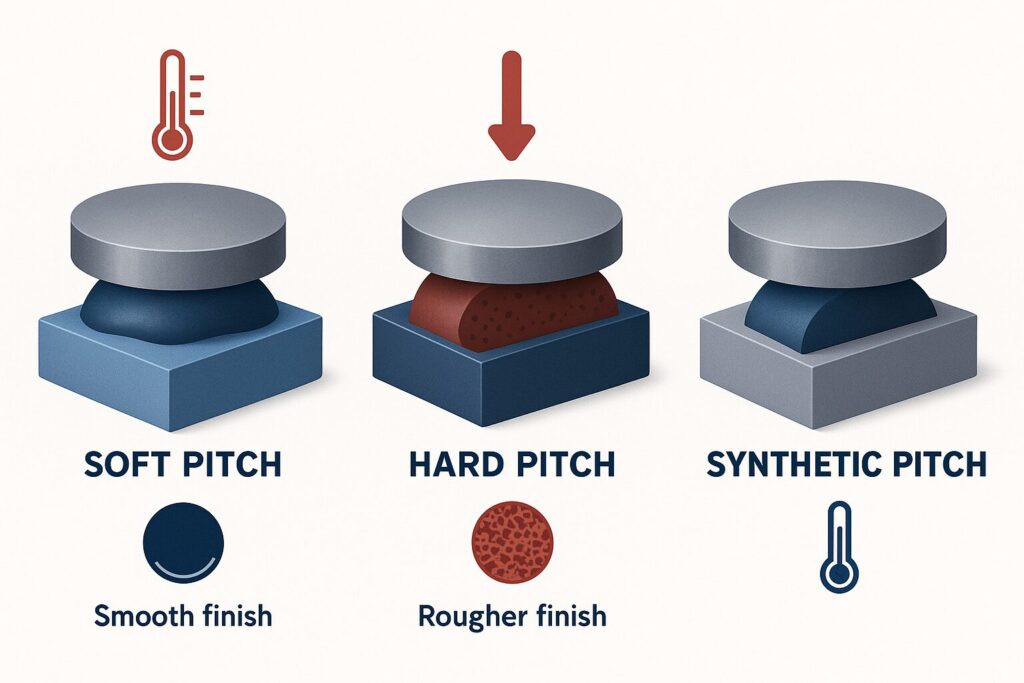 Not all pitches behave the same, and understanding their differences is key to achieving consistent polishing outcomes. Natural pitches such as Gugolz, derived from refined tree resins, have long been used in optical fabrication. They are prized for their viscoelastic properties, which allow the lap to flow under long-term pressure while still transmitting force during short-term contact. However, natural pitches can vary in performance depending on impurities, environmental conditions, and even batch-to-batch differences. To stabilize these variations, shops often need to “season” or condition natural pitch laps before use.
Synthetic pitches such as Cycad and Acculap were developed to address these limitations. By engineering chemical formulations in a controlled way, manufacturers can deliver predictable performance, reduce sensitivity to impurities, and minimize variability caused by temperature or humidity swings. Synthetic pitches also maintain stability over time, avoiding the aging effects that natural pitches can develop.
Pitch hardness is most often described in terms of softening point, the temperature at which the pitch begins to flow. For example, Gugolz 64 is softer and conforms easily to the optic, producing very smooth finishes, but it wears quickly. Gugolz 73 is harder and more durable, making it suitable for longer runs and higher loads, though it risks leaving rougher textures on the surface. Synthetic pitches expand this control by providing additional data on hardness and viscosity, allowing users to fine-tune lap behavior more precisely. Environmental factors are important as well; a pitch that works perfectly in a 20 °C shop may soften excessively in a 30 °C summer environment. Synthetic formulations often provide the most stability in variable conditions.
Selecting the right pitch requires balancing surface finish requirements, durability, and environmental stability. For ultra-smooth finishes such as those required in laser optics, softer pitches are generally preferred despite their higher maintenance needs. In high-load polishing of large optics or in production settings where lap durability is critical, harder or synthetic pitches are favored. In shops that experience seasonal fluctuations in temperature or humidity, synthetics typically deliver more consistent results, reducing the need for frequent re-conditioning. For corrective polishing, medium-hard pitches can provide the right balance between holding figure and maintaining smooth surface contact.
Several practical considerations influence pitch performance. Thicker laps made of softer pitch may deform under heavy load, reducing figure control, while harder pitches can be used in thinner layers without collapsing. Softer laps require more frequent grooving, pressing, and slurry maintenance to sustain performance. Harder laps, though more durable, can accumulate mid-spatial frequency tool marks if not carefully managed. Some shops even blend natural and synthetic pitches to create custom laps that combine conformity with stability.
The correct choice of pitch is never one-size-fits-all. Each decision must weigh the trade-offs between finish quality, process stability, and lap durability. Shops that master the balance between hardness, environment, and optical requirements are far more likely to meet specifications efficiently and avoid costly rework.