
What You Will Learn
- How pitch hardness/viscosity shift with temperature and volatiles
- Practical temperature handling to prevent aging and brittleness
- How to condition and press a lap for stable performance
Simple Explanation
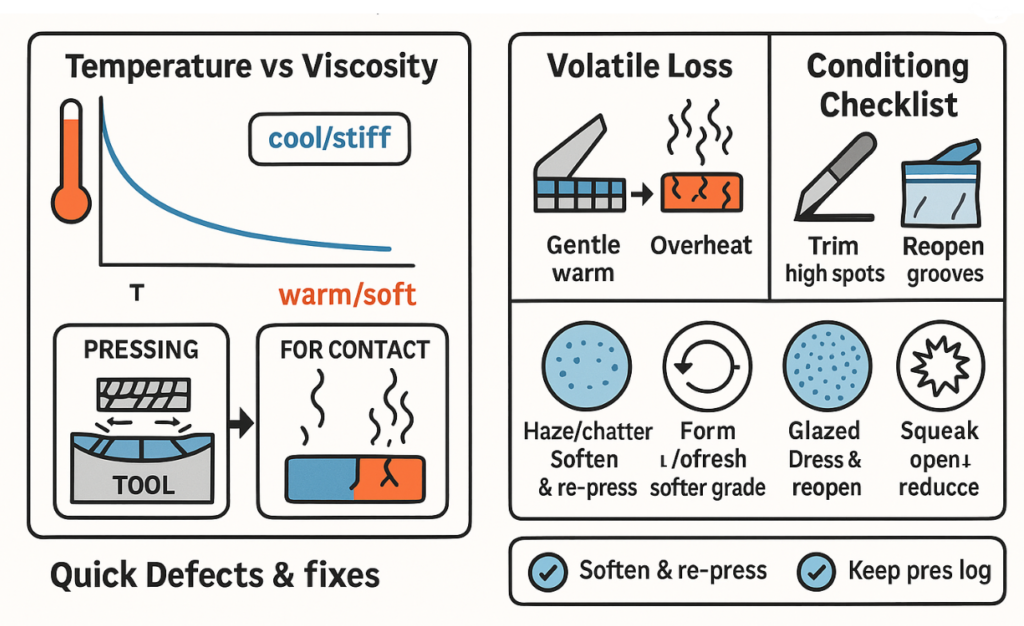 Pitch is a special “sticky solid” made from resins and oils. Those oils (often called volatiles) help the pitch flow just enough to match the glass. When you heat pitch gently, it softens and can be shaped; when you let it cool, it holds its shape. If you overheat it for too long, the light oils escape into the air. The pitch then turns hard and brittle, like taffy that’s been left out. A hard, brittle lap won’t fit the part well and can leave texture on the surface.
A good routine is to warm the lap just enough that a thumb press leaves a shallow mark, then press the lap against the tool or part so the contact evens out. Keep the grooves open so slurry can move, and trim any high spots so pressure stays even.
Deeper Explanation
Pitch stiffness is often described by its softening point. A higher softening point means a stiffer pitch at the same room temperature. Viscosity—the “thickness” of the flow—changes a lot with temperature. Even a small temperature rise can make the lap flow more and increase compliance, while a small temperature drop can make it stiff and reduce contact. Because of this, room temperature changes, lamp heat, or a warm slurry can all shift how a lap behaves during a run.
Volatiles are the light oils that keep pitch workable. Long, hot heating drives them off and ages the lap. An aged lap can “print” its own texture onto the glass or cause chatter because it no longer conforms well. Choosing the right pitch helps: a stiffer grade is better for high pressure, faster speeds, or when you want strong shape control; a softer grade is better when you want smooth cosmetics on larger tools. Natural and synthetic pitches exist; some synthetics hold their properties more steadily over time, while natural blends may feel more familiar to some operators. Whatever you pick, consistent temperature handling and regular pressing matter more than any single brand name.
Shows contact uniformity vs. temperature, time at temperature, and pressing/conditioning. Compliant = soft enough to conform and carry slurry evenly.Pitch Behavior, Volatiles & Conditioning
Lap Contact Map
Firm = higher control but less forgiving; watch contact uniformity.
Brittle (aged) = volatiles lost; face chips/glazes easily—refresh and re-press.Adjust parameters
Process Steps
Operator Tips
Common Defects & Fixes
Key Takeaway