
Lesson 1: Introduction & Purpose of Polishing
What You Will Learn
- Define the objectives of conventional polishing in optics
- Explain subsurface damage (SSD) and its connection to prior grinding
- Relate figure/irregularity, MSF, and center thickness to polishing outcomes
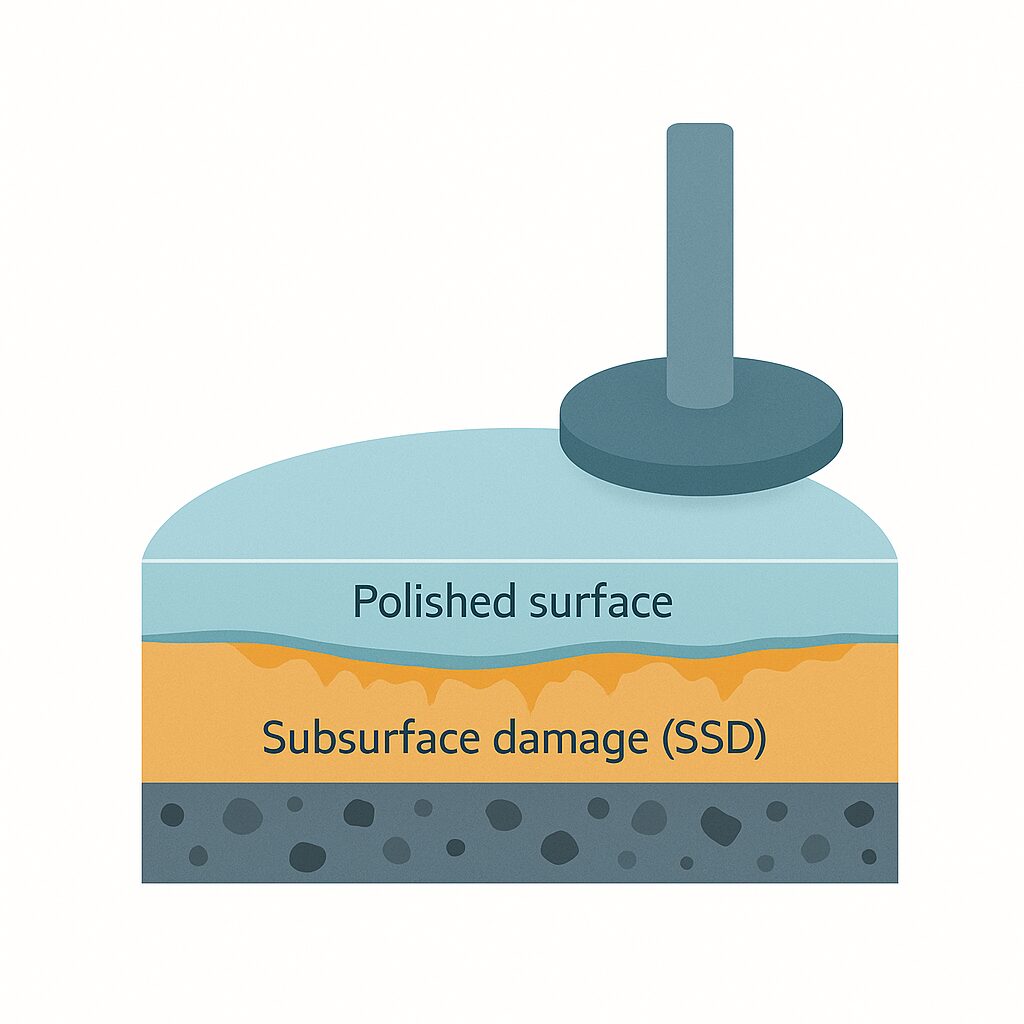 Polishing is the stage of optical fabrication where a part transitions from a mechanically shaped blank to a finished optical component. Grinding establishes curvature and surface geometry, but it also leaves behind surface defects and hidden structural weaknesses. Abrasive particles used in grinding drive micro-cracks and fractures beneath the visible surface, creating a layer known as subsurface damage, or SSD. This hidden layer can compromise the part’s strength and performance, especially when exposed to the stresses of high-powered laser beams or mechanical loading.
The objective of polishing is to eliminate this damaged layer, leaving a pristine smooth, defect-free surface that can transmit or reflect light and withstand the demands of its application. Polishing must refine the optical figure, so the surface matches the intended prescription. Even small deviations from curvature or irregularities of the surface shape will distort wavefronts, reducing image quality of systems. Polishing also has the role of improving the surface texture and cosmetic appearance, removing scratches, digs, and mid-spatial frequency errors that might otherwise scatter light or create unwanted reflections.
A successful polishing process therefore balances multiple objectives at once: removing SSD, controlling the figure, eliminating texture and cosmetic defects, and maintaining dimensional accuracy such as center thickness. The end result is an optical component that is not only strong and reliable but also capable of performing at nanometer-scale precision.