
Lesson 10: Troubleshooting & Best Practices
What You Will Learn
- Fast Diagnosis for Form, Cosmetics, And Process Stability
- How To Correct MSF, Sleeks, Haze, Burn, And Edge Conditions
- Preventive Maintenance for Laps, Slurries, And Motion Paths
Simple Explanation & Example
Most polishing problems are the result of the following: contact, compliance, motion, or slurry. Intimate contact of the pitch lap to the surface of the optic is necessary for proper polishing. Pitch can be warmed and pressed to be reformed to the surface of the optic. Changes in temperature can cause distortion of the pitch polisher shape. Adding more grooves to the polisher make the pitch more compliant and allow the pitch to flow and form to the surface more easily. Check thickness of the pitch on the polisher, visually looking at the edge of the polisher. Less pitch makes the polisher less compliant. Adjusting polisher oscillation and speed to randomize motion and mitigate recuring patterns. Listen for vibration, chatter, or squeaking indicating poor contact between the optic and the pitch lap. Keep the slurry conditions consistent (monitor concentration, pH, and filtering). Change only one thing at a time and write it down.
Fast Diagnosis
- Figure Error. Evaluate the figure error via test plate or interferometer. Consider if part is changing radius or is under stress. Evaluate blocking method being used to hold part. Stress from blocking can influence figure error. Physical geometry of the optic (aspect ratio: relationship of part thickness to diameter, optics with an aspect ratio > 8:1 are subject to flexing and distortion caused by force and stress. If the shape keeps changing in the wrong direction: check polisher size and confirm the supporting tool radius. Warm-the pitch with warm tap water and re-press the lap, check slurry temperature, and even out groove sizes. Adjust stroke speed and stroke length if zone continues to get worse.
- MSF Or Texture. Add a randomness to the path, change groove pattern to break up pattern, avoid very hard pitch, look for hard spots in the pitch (discoloration in the pitch surface), listen for chattering and squeaking coming from the polisher.
- Sleeks Or Haze. Clean and filter the slurry, if the slurry is new there may be some agglomerates (chunks) of slurry particles (use and ultrasonic bath to break down slurry particles. Confirm slurry particle size (APS: Average Particle Size). Check slurry PH with litmus strips or digital PH tester, adjust pH gently toward neutral.
- Burn Or Heat Marks. modify the slurry pH, understand the chemical reactivity of the material being processed, adjust slurry pH to compliment the materials chemistry. Materials that have a natural reactivity to Acids, should be polished using a slurry that’s more basic. Materials that react to more base liquids should be polished with slurry that is more acidic. Increase grooving on the polisher for better lubrication slurry flow, reduce down pressure on polisher.
- Edge Problems. Re-establish full, even contact of the polisher to the surface. Figure error at the edge could be caused by too much polishing (edge roll, down edge) or not enough (lip, up edge). Open any closed grooves too much friction or force at the edge. If a down edge is present, change oscillation so that polisher isn’t dwelling on the edge as much. If an up edge is present change oscillation so that polisher dwells more at the edge. Edge figure error problems can be the result of thin edge parts, stress caused by blocking methods can present edge error. Reduce weight, down pressure during polishing.
- squeaking, chattering, or poor rotation. re-press polisher to part with warm water. Rebuild uniform facets so pressure spreads smoothly. Make a new polisher with new pitch. Check for hard spots or discoloration of the pitch. Add small grooves to the polisher facets, break up the polisher surface area. Try softer pitch. Reduce weight/down pressure.
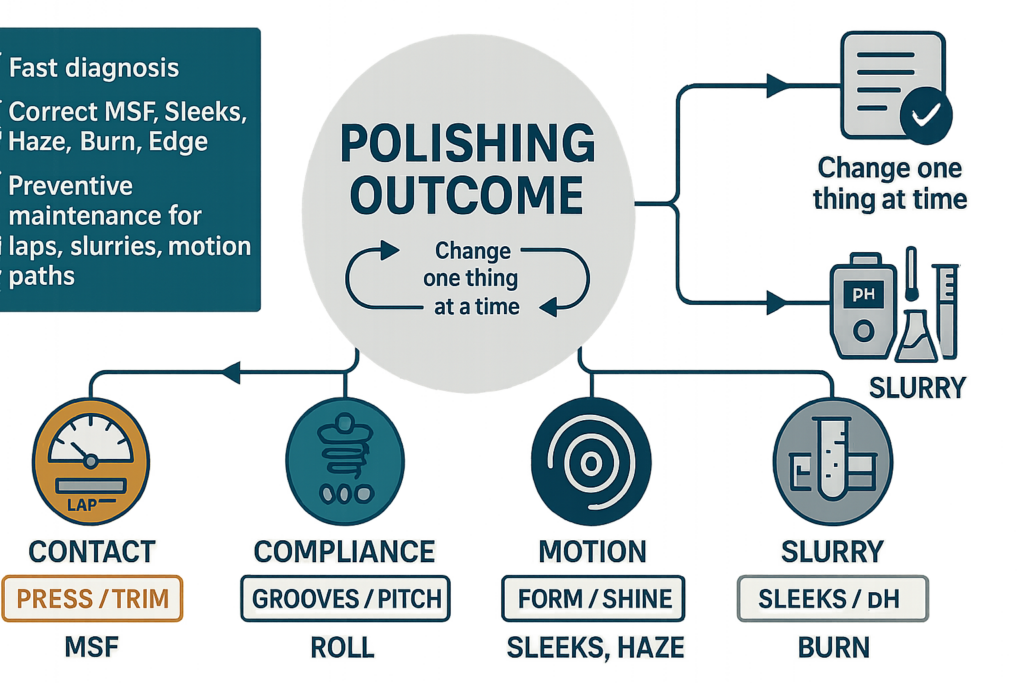 Process Controls
- Lap control- Facets the same size even across the polisher surface area, keep grooves open
- Motion control- Stroke, oscillation (sweep), and speed: longer, gentler steady motion for form and figure irregularity.
- Slurry control- maintain concentration (Baumé), stable pH, good filtration, and consistent recirculation (no clumps, no settling), slurry temperature.
- Environment control- Stable room temperature and humidity. Look for drafts and air flow that might chill the slurry or the polisher or the part.
Operator Tips
- Keep a run log: tool ID, pitch grade, groove pattern (take pictures, use ruler for scale), slurry Baumé, pH, room and slurry temperature, pressure, and before/after metrology.
- Maintain control of the radius! Controlling the radius of curvature will help with maintaining control of figure error.
- Use the same warm-up and pressing steps; the pitch will begin to change shape the minute it is removed from the optical surface. Change in shape of the polisher creates mismatch between optic and polisher causing figure error changes.
- Make only one change at a time – methodical purpose driven changes to pressure, time, temperature, motion, or chemistry-and record the result so you can repeat what works. After change is made observe change in form and figure error via metrology to assess effect of change (good or bad). Small changes will take more time to impact result. Large changes will impact result more quickly.
- Glass chemistry will affect slurry chemistry, materials with alkaline content makes the slurry pH increase over time, document the change over time and gently correct with a mild buffer or refresh the tank so results stay steady.
- Confirm finish with a visual inspection of surface using high illumination light source and dark background with minimal ambient light. Scratch-dig and a roughness evolution provide information on effectiveness of polishing parameters. Be sure surface meets blueprint specifications before passing part on to next step.
- Document all aspects of the process parameters when polishing is working best. Take videos and pictures of set up and settings to aid with repeatability later.