
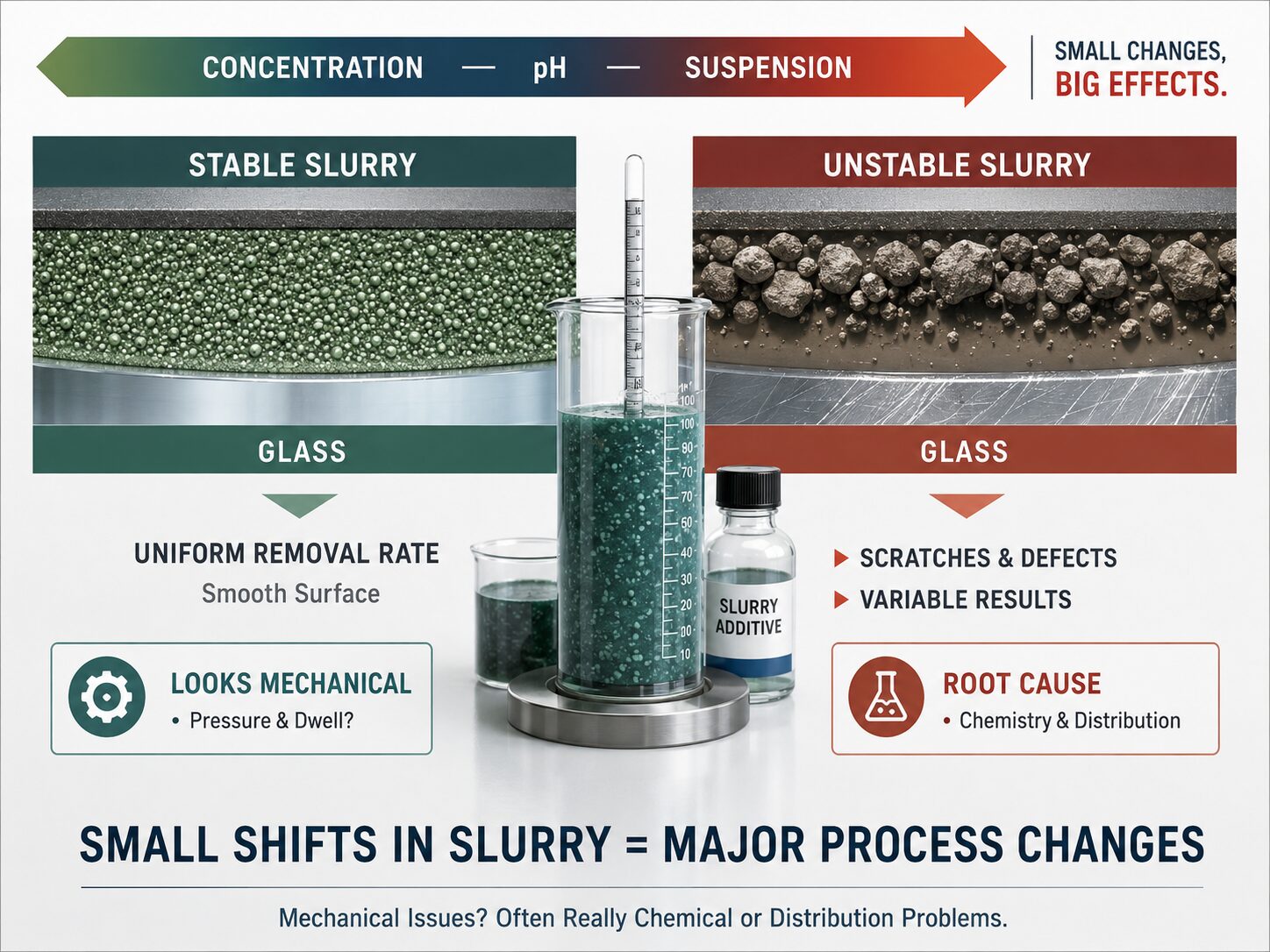
Why Slurry Control Drives the ProcessSlurry is the mixture of abrasive particles and a liquid carrier. The slurry contributes to the process environment. Small changes in concentration, pH, or stability can shift removal rate, surface finish, and defect generation. Many polishing problems can be the result of chemical or distribution issues. Consistent results depend on keeping the slurry in a controlled, repeatable state throughout the run.
Concentration defines how many active particles are available at the interface. Too low, and the material removal rate goes down increasing process time and can lead to lower quality surface finish. Too high, and particles interfere with each other, increasing scratching. Baumé is the measurement liquid buoyancy, to quantify the concentration of the slurry. A hydrometer provides a quick evaluation of the slurry concentration. This should be paired with known mix ratios so operators can validate both initial setup and drift over time. The key is not just hitting a number once, but maintaining it as evaporation, slurry loss, and dilution of the mixture over time during processing.
pH directly influences how particles interact with each other and with the work surface. In many slurries, especially colloidal systems, pH determines surface charge. When particles carry similar charges, they repel each other and remain evenly dispersed. When pH drifts toward neutral or outside the stable range, that repulsion weakens and particles begin to agglomerate. Agglomeration effectively creates larger particles, which can introduce scratches and increase subsurface damage. At the same time, chemical activity at the surface, especially in ceria and silica systems, depends on maintaining the correct pH window. This means pH is not just a chemistry parameter; it is directly tied to both finish quality and removal behavior.
Even a perfectly mixed slurry will separate if left static. Particles settle under gravity, leading to inconsistent delivery across the polishing surface. Agitation keeps particles suspended and ensures uniform distribution across the tool. The goal is steady, controlled movement, not excessive turbulence. Over-agitation can introduce air, foam, or instability, while under-agitation allows settling and localized starvation. Proper flow ensures that fresh abrasive is continuously presented to the interface while worn or spent particles are carried away.
Lubricity modifiers, such as glycols and surfactants, influence how the slurry flows and how particles interact with both the tool and the surface. Increased lubricity can reduce friction and scratching but may also reduce removal rate if overused. The balance depends on whether the process priority is material removal or surface quality. Additives must be used intentionally. Each addition changes not only flow behavior but also how particles engage the surface. Uncontrolled use can shift the process out of its validated window.
Suspension aids are used to prevent particles from settling and to maintain a uniform distribution over time. These additives increase the effective stability of the slurry, especially in systems where continuous agitation is limited. Products like Everflo or Suspendex are designed to keep particles evenly dispersed, reducing the risk of concentration gradients within the system. Without proper suspension, even a well-mixed slurry can become inconsistent during operation, leading to variation in removal and defect formation.
In colloidal slurries, stability is governed by electrostatic forces. Particles carry surface charges that cause them to repel each other, preventing clustering. This balance is highly sensitive to pH and ionic conditions. When the system is within its stable range, particles remain discrete and uniformly distributed. When the slurry becomes unbalanced, particles can rapidly clump, forming clusters that behave like oversized abrasives. This transition can happen quickly and is often difficult to reverse during a run, which is why maintaining the correct chemical environment from the start is critical.
Slurry control does not stop at setup. During operation, concentration, pH, and temperature all drift. Standardizing renewal intervals ensures that fresh slurry replaces degraded material before performance drops. Filtration removes oversized particles and contaminants that can drive defects. Temperature control maintains consistent viscosity and chemical activity. Together, these controls keep the process stable over time rather than allowing gradual degradation.
This interactive shows how changes in slurry concentration, pH stability, agitation, and slurry condition can affect both the appearance of the slurry and the polishing process. By comparing different states, you can see how problems such as settling, agglomeration, over-agitation, or degraded slurry may lead to unstable removal, surface defects, or inconsistent results.
Choose a slurry variable, then compare states to see how concentration, pH, agitation, and slurry condition affect polishing behavior.
The most effective control comes from linking slurry parameters to measurable outputs. Tracking roughness, cosmetic defects, and removal rate alongside concentration and pH logs allows operators to see cause-and-effect relationships. Over time, this builds a process window where acceptable variation is known and controlled. When the process drifts, adjustments can be made based on data rather than guesswork, keeping the system centered and predictable.