
Lesson 7 – Slurry Fundamentals (Type, APS, Shape, Distribution)
What You Will Learn
- Differentiate common abrasive chemistries and where each is typically applied
- Define APS and understand how particle size distribution impacts both removal and finish
- Relate particle shape and friability to removal behavior and cosmetic risk
- Select slurry based on both wavefront requirements and cosmetic specifications
- Establish concentration and pH control windows before production begins
Chemistry & APS
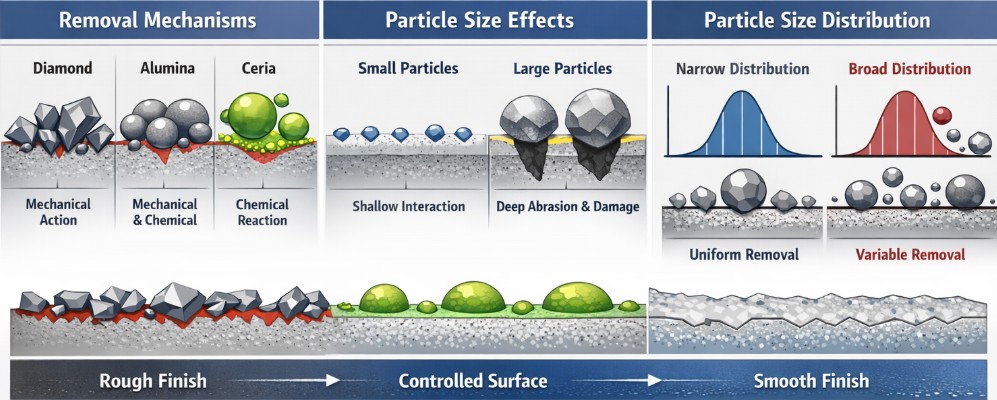
Slurry chemistry primarily affects the interaction of with silica-based glasses. The pH of the slurry can impact the removal rate and surface quality when optimized for the optical materials natural chemical reactivity rate. Slurry pH can also affect how well the abrasive particles stay in suspension in the slurry mixture. Controlling slurry pH will affect surface finish as well as the slurry mixture. APS, or average particle size, sets the scale of interaction between abrasive and surface being processed. Smaller APS values reduce the depth of the damage introduced into the material during polishing, leading to smoother finishes but slower removal. Larger APS increases removal rate but also increases the likelihood of scratches and subsurface damage. Equally important is the particle size distribution. A tight distribution produces consistent, predictable cutting behavior and is preferred for finishing steps. A broad distribution of APS introduces variability, where larger particles dominate removal and smaller ones fill in the gaps, often resulting in mixed surface quality. Even a small population of oversized particles can drive defect formation, so distribution control is often more critical than APS alone.
Particle Shape and Size Effects
Diamond is purely mechanical and highly aggressive, making it suitable for hard materials. Diamond abrasive slurries do not break down as quickly over time, which is why it is necessary to reduce the Average Particle Size (APS) during final finishing. Fine finishes can be achieved by stepping down in abrasive size, removing damage from the larger particles. Alumina provides a balance of mechanical removal and controllability, can be used as a finishing slurry for crystallin materials, as the particles will break down and smooth over improving surface finish on non-silica-based substrates. Cerium Oxide uses a balance of mechanical material removal as well as chemical reaction with silica-based glasses. This Chemo-mechanical interaction is particularly effective on glass, where it can produce very smooth finishes at controlled rates. Colloidal Silica is typically used for final polishing where low removal rate and high surface quality are required. Particle shape determines how abrasives interact mechanically with the surface. Angular particles tend to cut more aggressively, increasing removal rate but also increasing the risk of scratching. Rounded or spheroidal particles tend to roll or slide, producing smoother finishes with less damage but lower removal efficiency. Shape also affects how particles move within the slurry film. Rounded slurry particle geometries promote stable flow and even contact, while others lead to intermittent engagement and localized damage. Over time, particles may fracture or dull, changing their effective shape and behavior. This friability can be beneficial if it creates a self-renewing process, but detrimental if it introduces inconsistency. Matching particle shape and hardness to the material being processed is critical to a positive result. Aggressive shapes may be appropriate when bulk material removal rate is the priority, finishing steps require shapes that minimize surface disruption while maintaining control.
Distribution & Stability
Beyond size and shape, the stability of the suspended slurry particles plays a major role in process consistency. Particles must remain evenly distributed within the fluid mixture to ensure uniform interaction across the surface. Settling, agglomeration, or separation leads to localized variations in particle concentration, which directly translates to uneven removal. Agglomerates are particularly problematic because they behave like large particles, even if the nominal APS is small. These rogue clusters can create scratches that are inconsistent with the intended process. Proper mixing, filtration, and handling are required to maintain a stable and predictable slurry. Slurry aging must also be considered. As the slurry is used, particles can break down or become contaminated. The slurry will undergo chemical change as the slurry ages. Glass chemical properties are added to the slurry as material is removed during polishing. These changes alter both removal rate and surface quality over time, making it important to define usage limits and refresh intervals. Monitoring slurry pH, age and concentration will all maintain process stability.
Concentration and pH Control
Concentration determines how many slurry particles are in suspension and interacting with the surface at any given time. Higher concentration increases removal rate but also raises particle compaction between the surface being processed and the polisher, decreasing material removal efficiency and potential defect formation. Lower concentration reduces risk but may lead to inefficient material removal rate or poor polishing. pH of the slurry influences chemical reactivity with the optical substrate material, especially in slurries like ceria or silica where chemical-mechanical interactions dominate. Small changes in pH can significantly alter removal behavior, either enhance smoothing or introducing variability. Maintaining a controlled pH window ensures that the chemical contribution remains stable throughout the process. Both concentration and pH should be defined and controlled before production begins. Drift in either parameter can lead to inconsistent results, even if all other conditions remain unchanged.
Specification Alignment
Slurry selection can be influenced by the final surface requirements of the optic as well as the material type. Cosmetic quality relies on minimizing scratches, pits, and haze. Process optimization to increase material removal rate could degrade surface quality. Selecting the appropriate slurry involves balancing removal rate with surface finish requirements. A process optimized only for bulk material removal may produce undesirable surface defects, while a process optimized for finish may be too slow. Validation through controlled trials is essential. Before committing to production, slurry performance should be verified against both wavefront and cosmetic metrics. This ensures that the selected parameters produce consistent, repeatable results under real conditions.
What This Means on the Job
Slurry is not just a consumable; it is an active part of the process that directly determines how material is removed. Small changes in particle size, distribution, shape, concentration, or chemistry can have significant effects on both performance and yield. By understanding these variables and controlling them deliberately, operators can reduce variability, prevent defects, and achieve both form and cosmetic targets more efficiently. Surface quality is driven as much by the slurry as by the machine. Controlling particle size, shape, distribution, and chemistry is essential to achieving a stable process that meets both wavefront and cosmetic requirements.