
Lesson 1 – Introduction to CNC Polishing
What You Will Learn
- Differentiate CNC polishing from conventional hand or pitch polishing
- Identify core elements of a CNC polishing cell (tool, pad, slurry, metrology)
- Explain how tool and material choice impacts removal, form, and cosmetics
- Summarize the operator training objectives for CNC polishing processes
- Connect process parameters to metrology feedback loops
 Understanding CNC Polishing
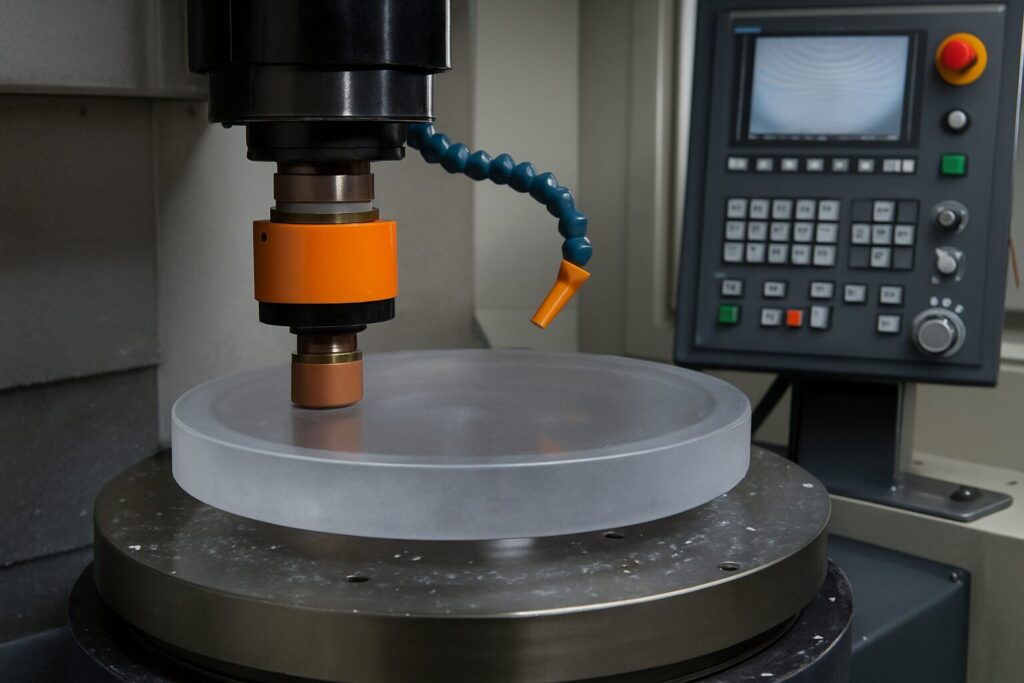
CNC polishing combines precision motion control with engineered tools and abrasive systems to achieve consistent removal rates, accurate form correction, and high cosmetic quality. Unlike hand or pitch polishing, which depends on operator skill and feel, CNC methods use programmable motion paths and carefully tuned parameters. This ensures repeatable outcomes across multiple parts and provides a quantitative way to refine optical surfaces.
A CNC system integrates mechanical control, process monitoring, and metrology feedback into a closed loop. Each step is deliberate, designed to produce a predictable response from the tool and surface. This repeatability is what makes CNC polishing the preferred choice for high-performance optical and precision surfaces.
System Components
Tooling
CNC tools are engineered bodies made of metal, glass, or composite materials that carry pads such as polyurethane or nylon. The geometry and stiffness of the tool affect pressure distribution and local material removal. Rigid tools are typically used for form correction, while compliant tools are preferred for smoothing and cosmetic improvement. Regular inspection and dressing of tool surfaces maintain consistent contact conditions.
Pads
Pads serve as the interface between the tool and the workpiece. Their composition determines how pressure and motion translate into surface removal. Polyurethane pads provide controlled removal and smooth finishes, while nylon pads can offer higher removal rates but may leave more texture. Over time, pads wear and change behavior, so they must be conditioned or replaced to preserve process stability.
Slurries
A polishing slurry consists of abrasive particles suspended in a fluid medium. Common abrasives include cerium oxide, aluminum oxide, and silica. Particle size, concentration, and chemistry determine both the rate of removal and the surface quality. The slurry’s temperature and agitation must be maintained within limits to ensure uniformity and prevent settling or contamination.
Machine Parameters
The CNC system controls force, relative velocity, dwell time, and temperature, all of which shape the removal function. Even small adjustments can significantly influence form correction and surface roughness. Understanding how each parameter interacts with the material is critical to optimizing performance and avoiding defects such as edge roll or center depression.
Metrology
Metrology provides the data needed to evaluate the surface and guide process adjustments. Interferometers or other surface profilers generate 2D and 3D maps that quantify deviations from the target shape. Operators use this information to identify symmetric and asymmetric errors and adjust polishing strategies accordingly. This feedback loop transforms polishing from an art into a measurable science.
CNC Polishing vs. Conventional Techniques
Conventional polishing methods rely heavily on manual skill to achieve the desired form and finish. While these techniques remain useful for prototypes or complex geometries, they can be inconsistent in high-volume or high-precision production. CNC polishing replaces subjective control with a data-driven approach. Parameters are defined, recorded, and adjusted based on metrology results, allowing for repeatable, traceable quality.
Operator Training Objectives
Operators must understand how each component, tool, pad, slurry, and motion, affects the final result. Training focuses on reading and interpreting metrology data, recognizing common process signatures such as center peaks, holes, edge roll, and astigmatism, and linking those signatures to specific causes. This ability to diagnose and correct issues in real time is essential for maintaining process capability.
Process Feedback and Continuous Improvement
CNC polishing is inherently iterative. Each polishing cycle generates metrology data that refines the next set of parameters. Operators learn to identify patterns in form evolution, such as improving or worsening spherical errors, and adjust dwell patterns or tool selection accordingly. Maintaining records of settings, results, and tool conditions builds a knowledge base that supports long-term process improvement and repeatable outcomes. CNC polishing transforms traditional polishing into a controlled, repeatable process driven by data and feedback. Success depends on a clear understanding of how tooling, pads, slurries, and machine parameters interact, and how metrology guides each adjustment. Through disciplined operation and iterative learning, CNC polishing achieves high-quality optical and precision surfaces that meet demanding technical standards.