
Lesson 7: Mid‑Spatial Frequency (MSF) Patterns
What you will learn
• Define MSF and recognize tool‑signature origins (vibration, ratio, pathing)
• Explain why MSF degrades optical performance even with low SSD
• Outline mitigations: balance, pathing, K‑ratio, finer steps
In this lesson, you will learn how to define mid-spatial frequency (MSF), recognize its origins in tool signatures such as vibration, kinematic ratios, and pathing, understand why MSF degrades optical performance even when subsurface damage (SSD) is low, and explore the practical strategies used to mitigate its effects.
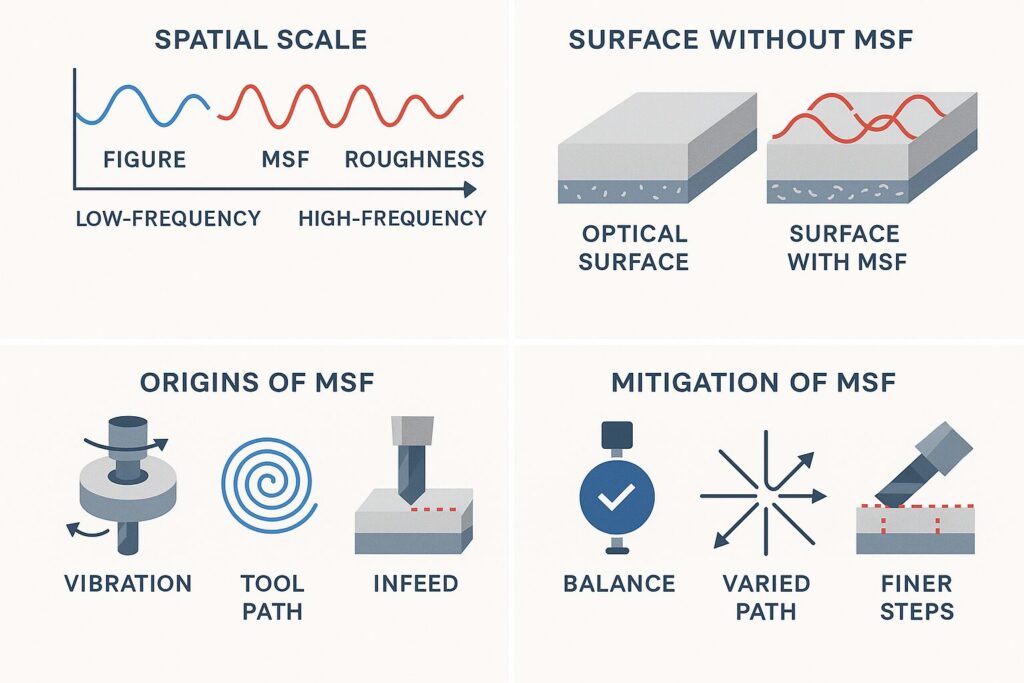 MSF describes surface patterns that occupy the space between fine roughness and large-scale figure errors. They often appear as periodic waviness that traces back to the mechanics of fabrication. Machine vibrations, spindle imbalance, cutter frequency, and deterministic tool paths all leave their imprint in this regime. Unlike SSD, which hides below the surface, MSF sits at the surface itself, where it interacts directly with light. Even a well-controlled SSD profile cannot protect against the scattering, diffraction, and wavefront distortion introduced by MSF. For high-performance optics, such as laser components and imaging systems, this loss of contrast and increase in stray light can be system-limiting.
The origins of MSF are varied. Vibrations and resonances from rotating spindles and machine structures inscribe repeating ripples. Poorly tuned K-ratios, where the balance of tool and workpiece geometry amplifies certain harmonics, leave recognizable marks. Tool paths that repeat predictably, whether in raster or spiral form, embed their own directional signatures into the surface. Even coarse step sizes during infeed create bands that survive into the finished optic.
Mitigating MSF requires treating these features not as random noise, but as engineered signatures that can be suppressed. Careful balancing of spindles reduces vibration. Adjusting the K-ratio helps decouple tool geometry from harmful resonances. Varying path strategies, introducing randomness or non-repeating sequences, disrupts the periodicity. Finally, finer steps and carefully tuned finishing passes smooth over residual mid-frequency features, blurring them without re-introducing subsurface cracks.
After SSD is under control, MSF often emerges as the next challenge. It is best understood as a hidden fingerprint of the process, one that must be deliberately engineered out through dynamics, path planning, and finishing discipline.