
Lesson 5: Grit, Mesh, and Concentration
Click on Slides for Audio
What You Will Learn
- Specify abrasives in microns, vendor-neutral, rather than only mesh
- Understand how concentration, for example C100 ≈ 25% vol. diamond, shifts removal rate, tool life, and finish
- Use grit step-downs to bound subsurface damage depth
Micron vs. Mesh, Why Specification Matters
Abrasives can be specified using either mesh size or micron size, but the two are not interchangeable in practice. Mesh numbers refer to the number of openings per linear inch in a sieve. The problem is that mesh grading can vary between suppliers due to differences in screening tolerances and distribution ranges. For example, a #1000 mesh abrasive from one vendor may fall between 12 and 18 microns, while another supplier’s #1000 may differ slightly in distribution.
Micron specification, by contrast, is vendor-neutral and directly tied to particle size. Ordering a 15 µm abrasive ensures a defined upper particle size limit. Because abrasive size largely determines the maximum potential depth of surface and subsurface damage, micron specification provides tighter control over SSD. As a rule, always specify abrasives by micron size when precision and repeatability matter.
| Parameter | Key Concept | Practical Guideline |
| Micron vs Mesh | Micron size is vendor-neutral; mesh varies by supplier. | Always order abrasives by micron size. |
| Concentration | C100 approx. 25% diamond. Higher = longer life, lower = freer cutting. | Tune concentration to machine, coolant, and geometry. |
| Grit Step-Downs | Each grit step must remove prior SSD with margin. | Plan grit ladders (e.g., 30-15-9-3 µm) for balanced cycle times. |
Diamond Concentration and Its Effects
Diamond concentration refers to the volume percentage of abrasive embedded in the bond matrix. C100 corresponds to approximately 25% diamond by volume. This level is often used as a baseline reference point in tool design.Concentration affects how the tool behaves under load:
Higher concentration:
- Increases stiffness
- Extends tool life
- Improves form retention
- May reduce cutting aggressiveness
- Can increase risk of plowing if parameters are not optimized
Lower concentration:
- Promotes freer cutting
- Can increase removal rate
- Reduces tool stiffness
- Shortens tool life
There is no universal “best” concentration. It must be tuned to machine rigidity, coolant delivery, part geometry, and removal objectives. A high-stiffness machine may benefit from higher concentration, while a more compliant system may require freer-cutting tools to avoid excess force and crack initiation.
Using Grit Step-Downs to Bound SSD
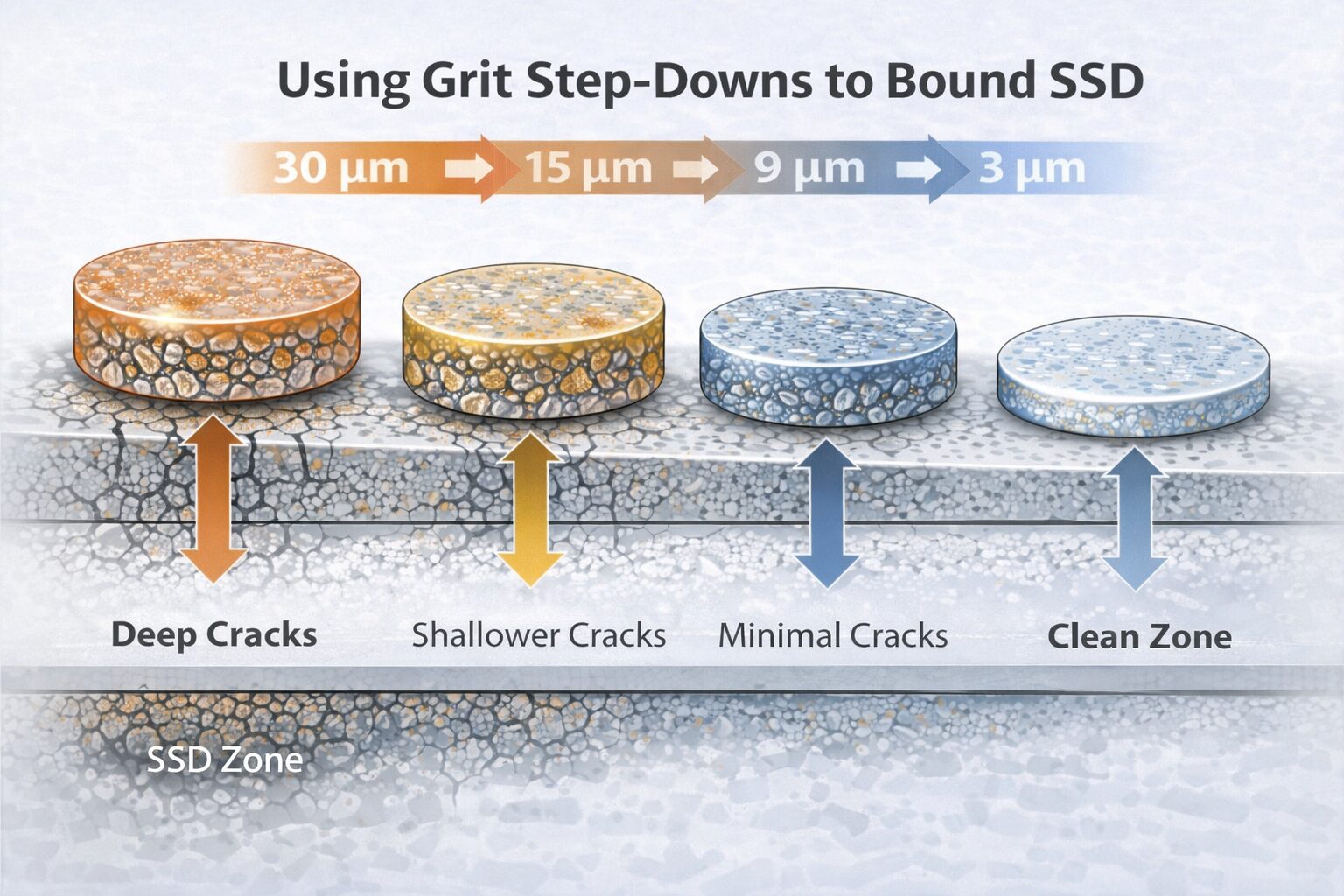 Grit size directly influences subsurface damage depth. Coarser grits create deeper cracks and larger fracture networks beneath the surface. Finer grits produce shallower SSD and smoother finishes. Because of this relationship, grinding must follow a structured grit ladder. Each step must remove not only the surface roughness of the prior grit but also its subsurface crack layer, with margin.
A typical example sequence might be:
30 µm → 15 µm → 9 µm → 3 µm
Each transition reduces the maximum crack depth introduced in the previous stage. Skipping steps may leave residual cracks that polishing cannot fully eliminate without excessive material removal. The objective is balance. Step-downs must be aggressive enough to efficiently remove prior damage, yet gradual enough to avoid unnecessary cycle time.
Practical Engineering Guidelines
When ordering tools, request micron size rather than mesh to ensure consistency across suppliers. Treat concentration as a tuning parameter rather than a fixed specification. Adjust it according to machine stiffness, coolant effectiveness, and part geometry. Design grit ladders that progressively strip away subsurface damage while maintaining efficient throughput. Each stage should leave a shallower and more uniform damage layer than the one before. Ultimately, grit size sets the ceiling on SSD depth, concentration shapes how the tool delivers force, and step-down planning ensures that damage is systematically engineered out of the optic.
Micron specification provides a vendor-neutral way to order abrasives, since mesh numbers can vary across suppliers. For example, a #1000 mesh abrasive may range between 12 and 18 microns depending on the vendor, whereas requesting a 15 µm abrasive ensures consistency. Micron sizing sets the upper bound on the depth of surface and subsurface damage.
Diamond concentration also plays a critical role in tool performance. At C100, which corresponds to about 25% diamond by volume, the tool offers a balance of stiffness, life, and finish. Increasing the concentration improves stiffness and tool longevity, but can reduce removal efficiency and increase the risk of plowing. Lower concentration tools cut more freely and can achieve faster removal, though at the cost of reduced tool life.
Finally, grit step-downs are essential for bounding subsurface damage depth. Coarse grits create deeper SSD, while finer grits leave shallower SSD. Each step in the grit ladder must remove the damage from the previous step with a margin. A sequence such as 30 µm to 15 µm to 9 µm to 3 µm progressively reduces SSD, ensuring that no residual cracks remain while maintaining efficient cycle times.
When ordering tools, always request the micron size rather than mesh. Tune concentration for your machine, coolant, and part geometry to balance removal rate and finish. Build grit ladders that progressively strip away SSD without wasted time.